



AI Assist · AI product launch
2.1×more visitors reaching sign-up for AI Assist. We redesigned its onboarding and launched the product in 8 weeks.
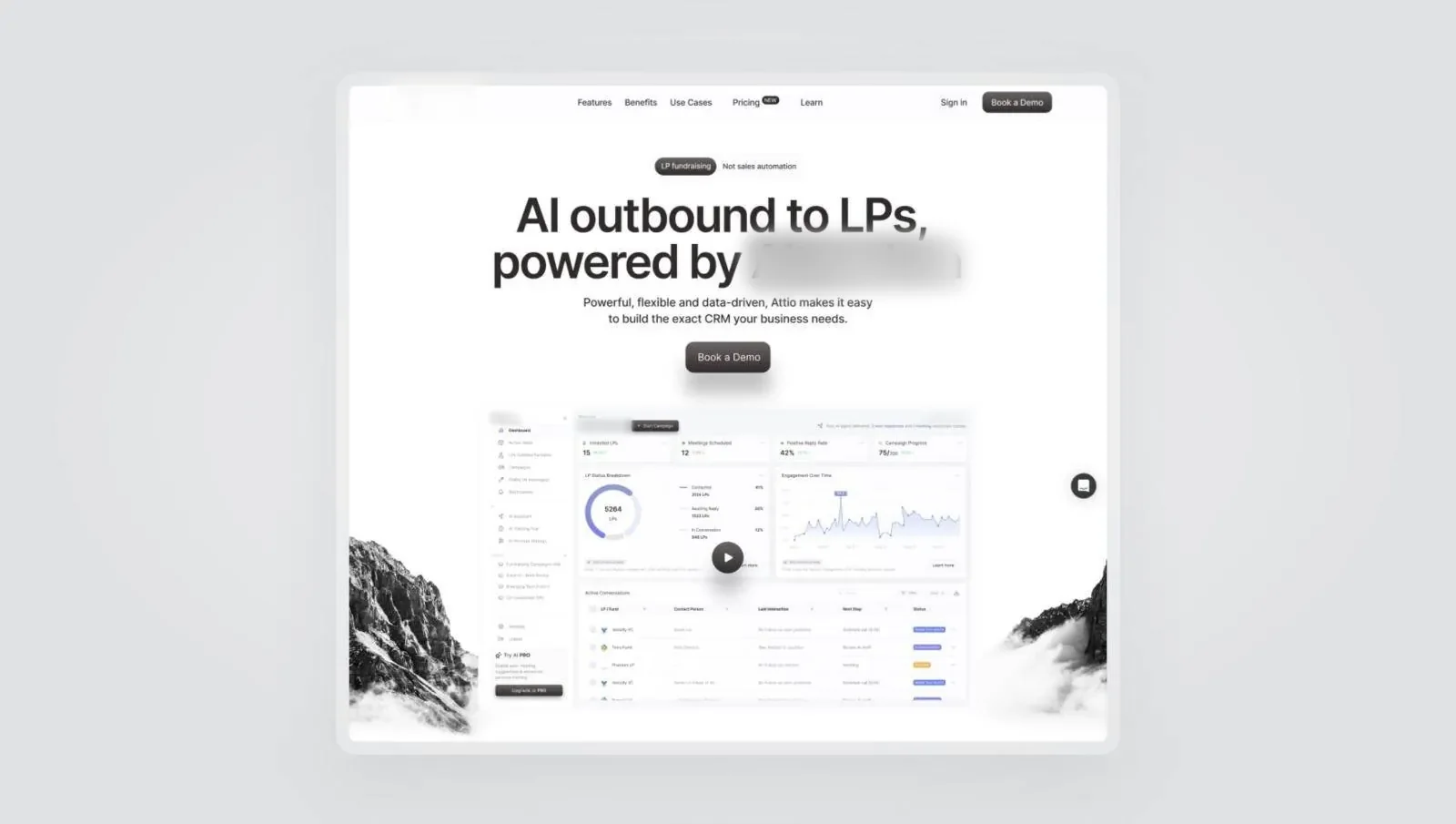
Website, product UX and agent UX for AI startups from seed to Series B, designed and built by one senior, founder-led team. AI Assist got 2.1× more visitors to sign-up. An AI outbound platform got 18% more demo bookings after its new site.
 By Ignat, founder of DIXI · Updated
DIXI designs and builds websites and product UX for AI startups from seed to Series B. One senior, founder-led team covers the homepage that explains your AI, the agent and copilot UX inside the product, and the build in Webflow, Framer, Astro or Next.js. AI Assist got 2.1× more visitors to sign-up. Sprints start at $8k.
Homepage, use-case, pricing and trust pages that say what your AI does, for whom and how well, on a CMS your team can edit.
Plans, approvals, citations, confidence and undo: the patterns that let people hand work to an AI and still feel in control.
The first session rebuilt around one useful result, with sample data, prompt starters and an honest line about limits.
Tokens and components for streaming, confidence, citations and errors, shared by the website and the product.
The team that designs it builds it, so nothing gets lost between the mockup and the live page. You own the code.
A Conversion Sprint on the page that decides your demos or sign-ups, measured against one metric agreed up front.
Lead with the outcome, prove it, then show it working. Many AI homepages open with a clever line about the future and a gradient, and buyers leave before they learn what the product does. We structure the page as claim, evidence, demo and limits, so a skeptical buyer, and an AI assistant summarising your site, gets the same clear answer in seconds.
One concrete line: what it does, for whom and how much better. YC’s design reviews warn that clever copy can backfire, and AI pages are where it backfires most.
Customer results, a benchmark with its method, named logos. Link to how you measured it, because buyers and AI assistants both check.
An interactive demo, a 60-second product video or a sandbox, high on the page. YC calls it the chance to “show off a feat of strength.”
What the AI does and doesn’t do, what data it uses and where a person stays in control. Saying it plainly is how you win the skeptic.
By making the agent’s intent, evidence and limits visible before, during and after it acts. Only 46% of people globally are willing to trust AI, yet 66% rely on its output without checking it (KPMG and the University of Melbourne, 2025). Good agent UX closes that gap from both sides: it earns trust where the agent is right and invites a check where it may be wrong.
| Pattern | The problem it solves | What we deliver |
|---|---|---|
| Intent preview and plan approval1 | The agent acts before people know what it will do, and one wrong action costs trust for good | A plan view with steps, scope and data access; approve, edit or reject each step |
| Autonomy setting1 | One setting for everyone: power users wait, cautious users panic | Per-task levels (suggest, ask first, act) with defaults by role and risk |
| Citations and rationale2 | People can’t check an answer they can’t trace | Inline source markers, a sources panel and a one-line “why” for each action |
| Confidence signals and review queues3 | A confident tone on a wrong answer is the fastest way to lose a user | Calibrated confidence states, low-confidence flags and a queue for human review |
| Action log and undo4 | If people can’t see or reverse what the agent did, they stop letting it act | A time-stamped log, undo per step and clearly marked points of no return |
| Escalation to a person6 | Stuck users with no way out churn or open tickets | A visible hand-off with the context attached, plus rules for when the agent escalates itself |
| Streaming and progress5 | Long silent runs look like failures | Streaming output, step progress, time estimates and a stop button |
| Approval gates for risky actions1 | Payments, emails and data writes need a human sign-off | Gates by action type and amount, with batch approval for low-risk items |
| Error, empty and cold-start states | A blank prompt box stalls the first session, which decides adoption | Prompt starters, sample data and errors that say what happened and what to try |
| Feedback loops | Teams can’t improve what users never flag | Light rating and correction on outputs, routed to your product and eval teams |
Pattern names follow Victor Yocco’s six agentic UX patterns (Smashing Magazine, 11 February 2026), Google PAIR’s People + AI Guidebook and Microsoft’s HAX Toolkit. Trust figures: KPMG and the University of Melbourne, 48,000+ people in 47 countries, May 2025. Checked 31 October 2026.
Three AI products, three different jobs: an onboarding redesign and launch, a website and product for an agent-run fundraising tool, and a website designed and built end to end. In each one the same team owned the message, the interface and the build.
more visitors reaching sign-up for AI Assist. We redesigned its onboarding and launched the product in 8 weeks.
demo bookings after the new website. We also designed the product: a dashboard for fundraising campaigns run by an AI agent.
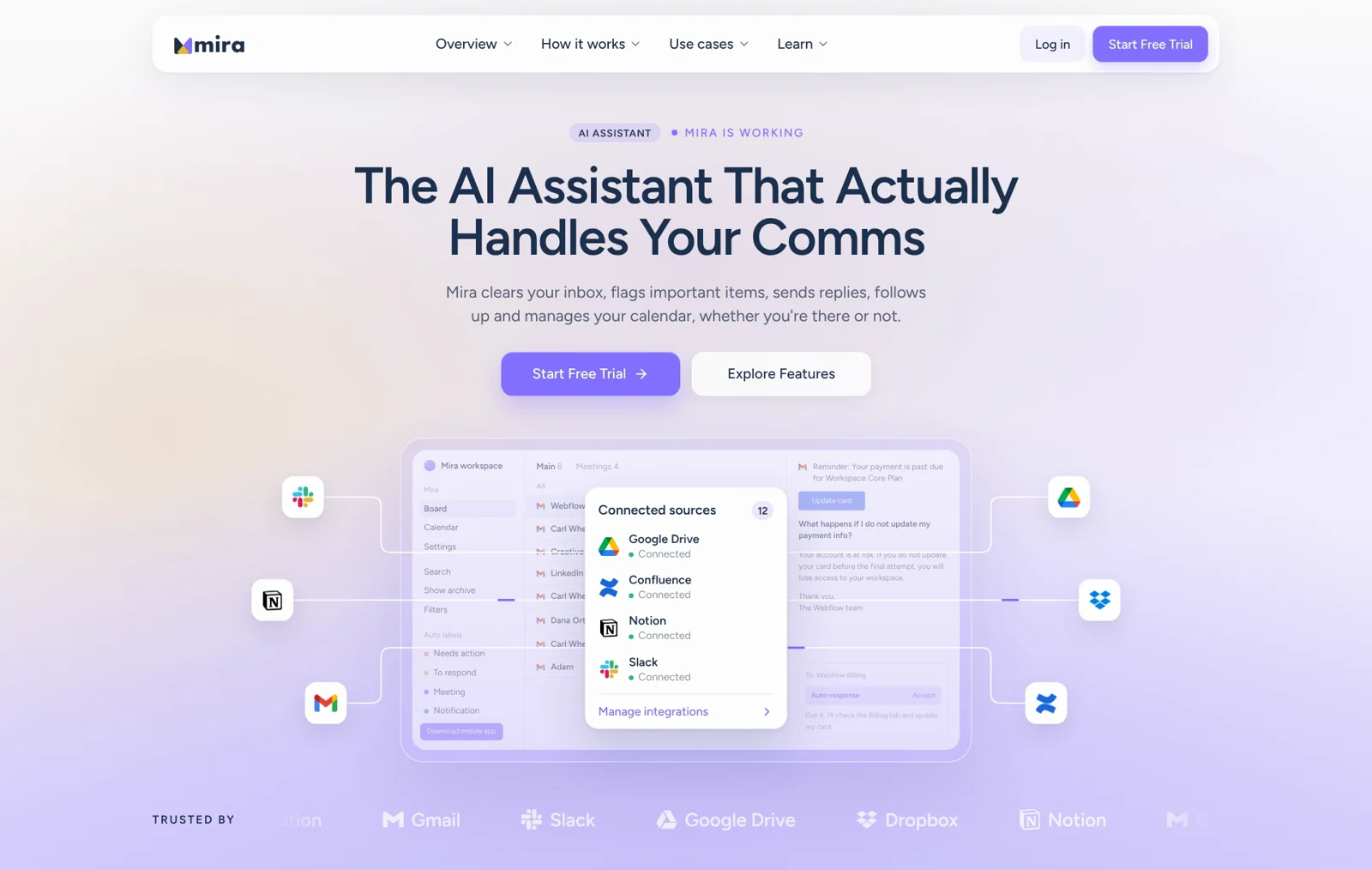
designed and built the website for Mira, an AI assistant that clears the inbox, sends replies and manages the calendar.
Client results are the work of each client’s whole team; design was one part. The AI outbound platform is shown without its name and data, under NDA.
Get them to one useful result in the first session, before asking for anything they can’t give yet. AI products win or lose there: Menlo Ventures found that product-led growth drives 27% of AI spend, about four times the rate in traditional software (December 2025). The product, not a sales call, has to make the case, so onboarding is where we start.
Source: Menlo Ventures, 2025 State of Generative AI in the Enterprise, 9 December 2025. We redesigned AI Assist’s onboarding and launched the product in 8 weeks.
Proof that your product is safe to roll out, findable without a sales call. Security reviewers, IT and legal read different pages from the champion who found you. We design a trust page and documentation entry points that answer their questions plainly: certifications, data handling, model use, access control and who to contact, with dates and links rather than adjectives.
It should let a buyer predict the bill. AI pricing is changing fast: in a May 2026 survey of 230+ B2B software and AI companies, 37% used hybrid pricing, 29% already sold AI credits and another 33% planned to within a year (Growth Unhinged). Each model needs its own explanation: what a credit buys, what happens at the limit and how a team’s cost grows.
| Pricing model | What buyers worry about | What the page needs |
|---|---|---|
| Per seat | Paying for people who barely use the AI | Clear seat definitions, AI included or as an add-on, annual and monthly side by side |
| Usage-based | A surprise bill after a busy month | A usage calculator, spend caps and alerts, examples at three team sizes |
| Credits | Not knowing what one credit buys | A credit table by task, rollover rules and top-up prices |
| Hybrid: seats plus credits | Two meters to understand at once | One worked example per plan, credits included per seat, the overage price in plain view |
| Outcome-based | How an “outcome” is counted, and disputed | The definition of an outcome, how it is measured, and a monthly cap |
Survey figures: Growth Unhinged, The state of B2B monetization in 2026, published 13 May 2026. What each page needs is DIXI’s practice.
With DIXI, a Conversion Sprint starts at $8k and takes 3–4 weeks, a website or product project starts at $12k and takes 6–10 weeks, and a design partnership starts at $6k a month for at least three months. Published market prices for AI design work run from subscriptions around $3,200 a month to agency minimums of $25,000 and up.
| Option | Published price | Timeline | What you get | Source |
|---|---|---|---|---|
| DIXI · Conversion Sprint | from $8k | 3–4 weeks | Audit and redesign of your highest-traffic page; build as an add-on | DIXI |
| DIXI · Website or product project | from $12k | 6–10 weeks | Website, product UX or both, designed and built | DIXI |
| DIXI · Design partner | from $6k a month | 3 months minimum, then monthly | Senior design in your team: product, agent UX and the site | DIXI |
| AI product design agency | $100–150 an hour, from $25,000 | Not published | AI product UX and UI | Fuselab Creative |
| AI and ML website studio | Not published; budget brackets on the form start at $10k–20k | 6–12 weeks | Website design and development | Halo Lab |
| Industry guide | $15k–60k focused; $60k–120k complex; $120k+ programs | Not stated | Typical ranges for AI design engagements, not one agency’s quote | Clay |
| Design subscription | $3,200 a month part-time; $6,400 full-time | Ongoing | A designer by subscription (UITOP) | ParallelHQ, July 2026 |
Third-party prices as published on each source, checked 31 October 2026: Fuselab Creative, Halo Lab, Clay and ParallelHQ. All DIXI formats: see pricing.
Match the format to what is breaking now. Before product-market fit, speed and a clear story matter most; after it, consistency and depth do. Most AI teams start with a Sprint or a project and move to a design partnership once they ship every week and the product, the site and the sales deck start to drift apart.
One page that explains the product, plus a UX pass on the MVP before users or investors see it.
Sprint, from $8kHomepage, use-case and pricing pages, plus onboarding and the core agent flow.
Project, from $12kSenior design inside your team: new features, agent UX and experiments on the site.
From $6k a monthA shared design system, trust pages and multi-role product UX for larger customers.
Partner or projectGood: you shipped fast. Before customers or investors see it, have someone review what the AI tools don’t: the path to first value, onboarding, accessibility, speed and front-end consistency. Our fixed-price audit shows you what to fix first in 3 working days, and the cleanup sprint after it fixes the front end with you. Penetration tests and back-end rewrites stay with specialists.
Why a second look matters: Veracode found AI-generated code introduced security flaws in 45% of tasks across 100+ models (July 2025), and TechCrunch reported that a quarter of YC’s Winter 2025 batch had codebases about 95% written by AI (March 2025). We check the security basics, such as database rules and keys in the bundle; it is a pass, not a penetration test.
We fit AI startups from seed to Series B with a working product, a budget from $8k and a founder or product lead who can make decisions quickly. If you need model training, a pitch deck on its own or a team of ten designers, we will say so on the first call and, where we can, point you to someone better suited.
A Sprint fixes the page that decides your demos. A project designs and builds your site or a product flow. A design partner joins your team as you ship every week.
Audit and redesign of your homepage or key page: message, structure, proof.
Full website or product redesign, with a design system your team can grow.
Ongoing product and web design, experiments and monthly reviews.
A bigger scope, several services at once or a different timeline. We will shape the format and the price around your project.
Pick by who does the work and who builds it. Big agencies bring large teams and process, at project prices to match. Freelancers are flexible but usually cover one discipline. AI site builders are fast for a first page but stop at the template. A founder-led studio fits when you want senior people designing and building the site and the product together.
| Option | Who designs and builds | Typical price | Who owns code and files | Best for |
|---|---|---|---|---|
| DIXI · founder-led studio | The founder plus senior designers and developers: website, product UX, agent UX and front end in one team | Sprint from $8k; projects from $12k; partner from $6k a month | You, in full, on your accounts | Seed to Series B teams whose site and product must tell one story |
| Big agency | A larger team with account management, often split across departments or partners | Industry guide: $60k–120k for complex AI projects (Clay) | Usually you; check the contract | Large rebrands and multi-team programs |
| Freelancer | One person, usually one discipline: design or code, rarely both at senior level | Hourly or per project; varies widely | Usually you; check the contract | A defined task with clear specs |
| AI site builder | You, with generated layouts and templates; product UX not covered | A monthly plan, plus your own time | Hosted on the builder; export options vary | A first landing page or a quick test |
Big-agency price range from Clay’s guide to AI-first design agencies, updated 1 October 2026. Other rows describe typical setups, not specific companies.
Websites in Webflow, Framer, Astro and Shopify. Products in React, Next.js and React Native.
 Webflow
 Framer
 Astro
 Shopify
 React
 Next.js
 React Native
 Swift
 Figma
 Cloudflare

I'm Ignat, and you work with me directly: no account managers and no handoffs, just a senior team that designs and builds your site.
With DIXI, a Conversion Sprint starts at $8k, a website or product project at $12k and a design partnership at $6k a month. Published market prices run from design subscriptions at about $3,200 a month (UITOP, as listed by ParallelHQ) to agencies starting at $25,000 (Fuselab), and one industry guide puts complex AI design projects at $60k–120k (Clay). See pricing for what each format includes.
A Conversion Sprint takes 3–4 weeks and a website or product project 6–10 weeks from kickoff. AI Assist’s onboarding redesign and product launch took 8 weeks. Ongoing work, such as new agent features every sprint, runs as a design partnership of at least three months and then month to month.
Yes, and one team does both, so the promise on your homepage matches what users find inside the product. For an AI outbound platform (name under NDA) we designed the website, after which demo bookings rose 18%, and the product: a dashboard for fundraising campaigns run by an AI agent. For AI Assist we redesigned onboarding and launched the product.
We design for calibrated trust rather than blind trust. Answers show their sources, the interface signals confidence and sends low-confidence results to a review queue, risky actions wait for approval, every action can be traced and undone, and there is always a way to reach a person. We also design the error states: what went wrong, in plain words, and what to try next.
All of them, chosen by risk: intent preview and plan approval, an autonomy setting, citations and rationale, confidence signals with review queues, an action log with undo, escalation to a person, streaming progress, approval gates for risky actions, cold-start states and feedback loops. The pattern table on this page shows what each one solves and what we deliver for it.
Yes. We build marketing sites in Webflow, Framer, Astro or custom code, and product front-ends in React and Next.js. You own every design file and every line of code, on your own accounts, from day one. Our tech stack page explains which platform fits which team.
Yes. Our AI MVP audit is a fixed $1,500 and takes 3 working days: the path to first value, onboarding, accessibility, speed, front-end consistency and the security basics, with a fixed quote for the fixes. The cleanup sprint after it takes about three weeks and is built in your own stack. Penetration tests and back-end rewrites stay with specialists, and we tell you when you need one.
Yes. We design pricing pages that let a buyer predict the bill: credit tables by task, usage calculators, a worked example per plan, overage prices in plain view, and caps or alerts. In a May 2026 survey, 37% of B2B software and AI companies used hybrid pricing and 29% sold AI credits (Growth Unhinged), so this page now carries more of the sale.
Yes. We design trust pages and documentation entry points that answer security, IT and legal reviewers directly: certification status with dates, data retention, whether customer data trains models, residency and subprocessors, SSO and audit logs, and who to contact. We write from what your team can actually state, never from marketing adjectives.
Yes. We sign an NDA before the first working session, work inside your Figma, tracker and repositories, and extend your design system rather than replace it. The AI outbound platform on this page appears without its name for exactly that reason.
Book a 25-minute call with Ignat, or start with a free teardown of your AI homepage.
We use essential storage to run this site. With your OK we also use analytics to see which pages help visitors. No ad tracking. Cookie policy
Choose what we can use. You can change this any time from Cookie settings in the footer.
 Ignat · Founder