Enterprise SaaS redesign case study · Executive compensation HCM International: a pay platform, from scratch.
HCM International advises 500+ companies on executive pay and governance. In 5–6 months, two DIXI designers rebuilt the platform behind its compensation reports, designed the internal app where consultants check client data, and refreshed the identity and website. After the relaunch, 22% more users reached a finished report.
 By Ignat, founder of DIXI · Updated
- ClientHCM International, Zurich and Geneva
- IndustryExecutive compensation advisory
- ServicesPlatform design, internal app, design system, identity, website
- PlatformsWeb, responsive, desktop app
- Timeline5–6 months
- Team2 senior DIXI designers; HCM’s in-house developers built it

“As we prepared for the relaunch, we needed to simplify a product that had become increasingly complex.”
Olga Beregova · Partner, HCM
The short version
HCM’s advice runs on data. Consultants collect and check each client’s compensation data, turn it into reports, and those reports drive the analyses and pay decisions that follow. The platform behind that work had grown complex. Two DIXI designers rebuilt it from scratch, designed an internal app for collecting and checking data, put both on one design system and refreshed HCM’s identity and website. HCM’s own developers built it. After the relaunch, 22% more users reached a finished report and core tasks took 35% less time.
Executive pay, decided on data.
- CompanyHCM International Ltd, an independent advisory firm in compensation, corporate governance, value based management and job architecture.
- Clients500+ companies, from large multinationals to mid-sized companies and start-ups.
- Experience20+ years of consulting at board and executive level; founded and led by Stephan Hostettler.
- OfficesZurich and Geneva, plus the GECN Group: 150+ professionals in 12+ offices worldwide.
- Business modelConsultants prepare compensation reports for each client; analyses and pay decisions follow from them.
- Why it mattersSince 2014, Swiss listed companies have put top-management pay to a binding shareholder vote every year.
What the reports answer The questions behind every screen
Say-on-PayHow does our CEO’s pay compare with our peer group before the shareholder vote?
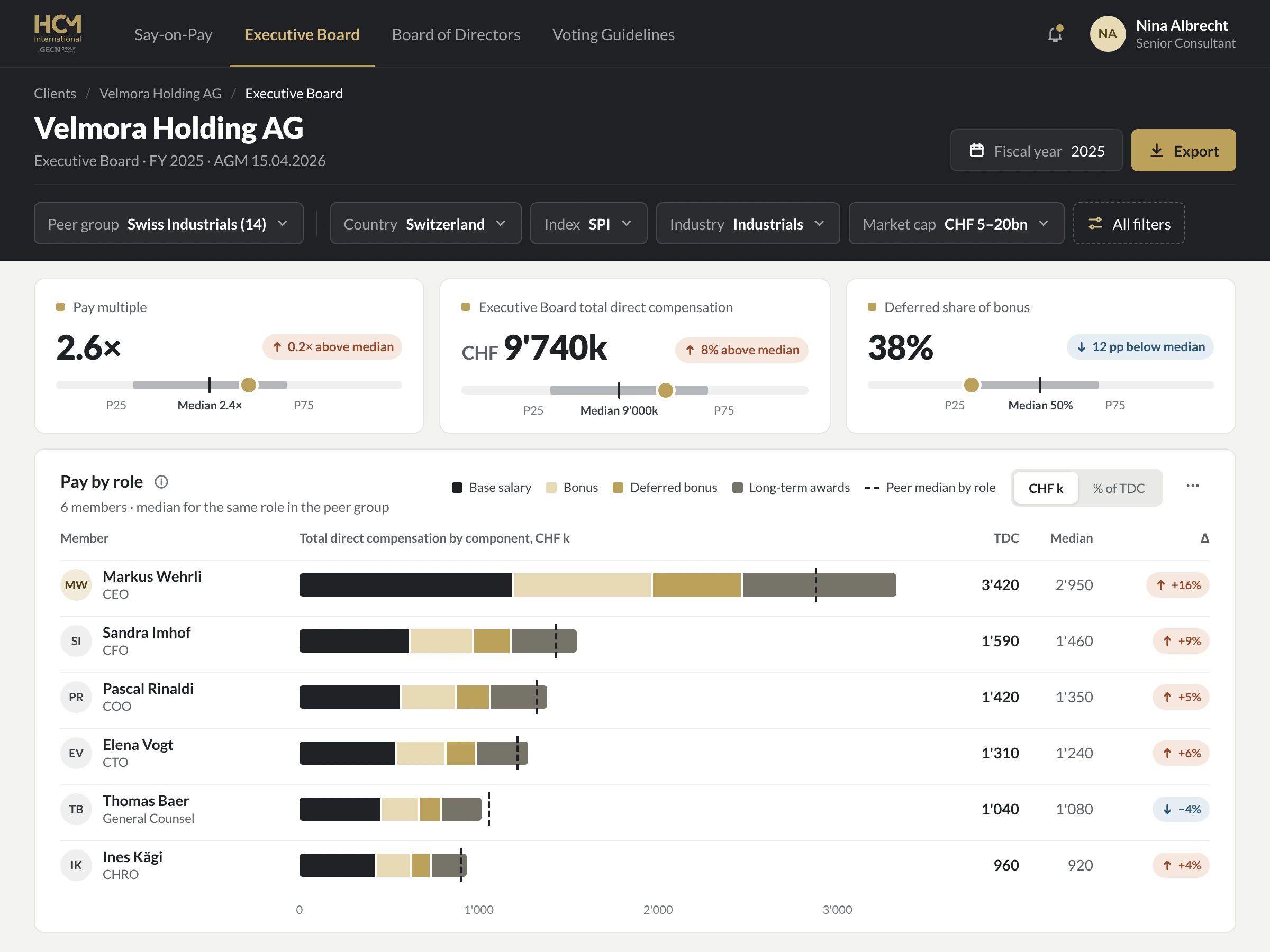
Executive BoardHow is executive pay split between salary, bonus, deferred bonus and long-term awards?
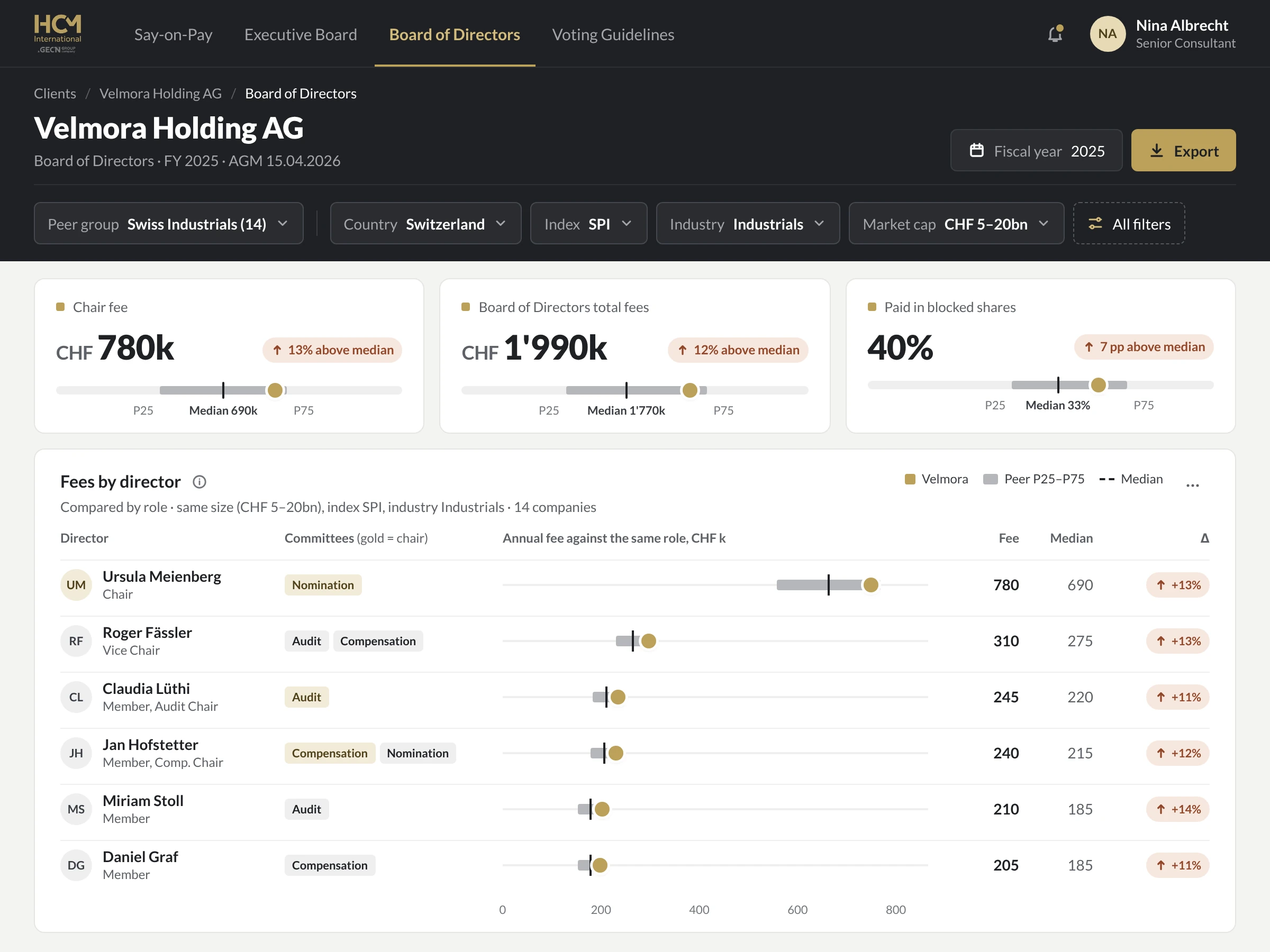
Board of DirectorsAre board fees in line with companies of our size, index and industry?
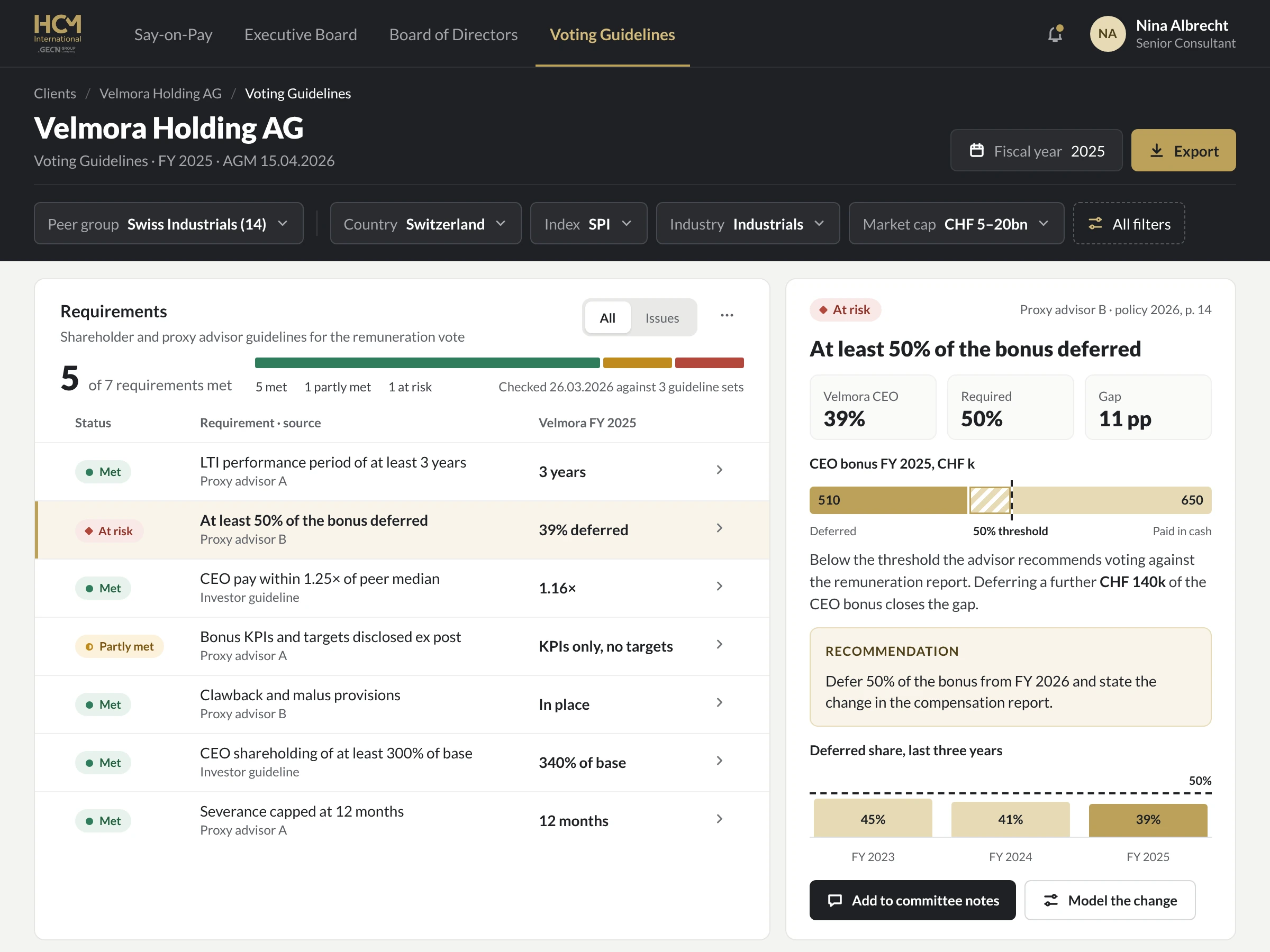
Voting GuidelinesHow are shareholders and proxy advisors likely to read our report?
Sources: HCM International; SGMI faculty page; Schellenberg Wittmer on the Swiss say-on-pay ordinance.Complex by nature, complicated by accident.
A product that grew feature by feature
Years of additions had made the platform hard to use. Every new feature made the existing workflows longer and harder to follow.
Few users reached the end
Only a small share of users completed the final steps of the critical workflows, the ones that end in a finished report.
Data work needed its own tool
Every report starts with collecting and checking a client’s data. Consultants needed a tool built for that work and connected to the platform.
Sensitive data, short timeline
Executive pay is confidential. Everything had to be clear and safe to use, and ready in 5–6 months.
Simplify the path, keep the depth.
Audit real user paths
We mapped where users dropped off and removed redundant data-entry loops left over from older versions.
Platform from scratch
New information architecture, flows and every screen, designed around the reports consultants produce.
One system, two products
The reporting platform and the internal app built from the same components and data formats.
Ready for HCM’s developers
Specs, states and components handed to HCM’s in-house team, reviewed with them as they built.
Two senior DIXI designers worked embedded with HCM’s partners, the consultants who use the platform with clients every day.
Three principles behind every screen
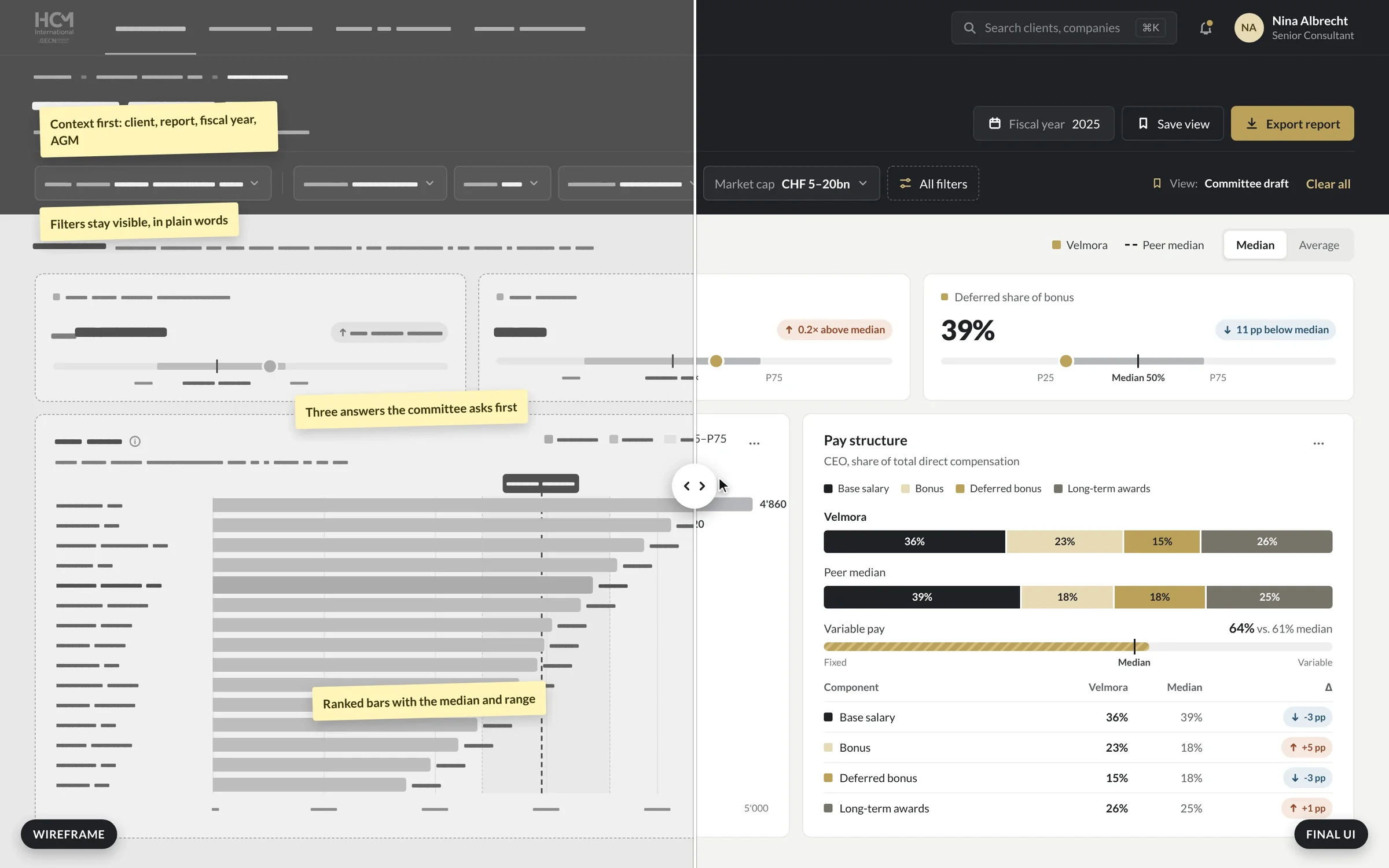
Answer first, details on demand
Each screen opens with the answer to the question a board asks, then lets you drill into the numbers behind it.
Context you can always see
Peer group, country, index, industry and market cap stay visible, so nobody compares the wrong companies.
Complete handoff, no guesswork
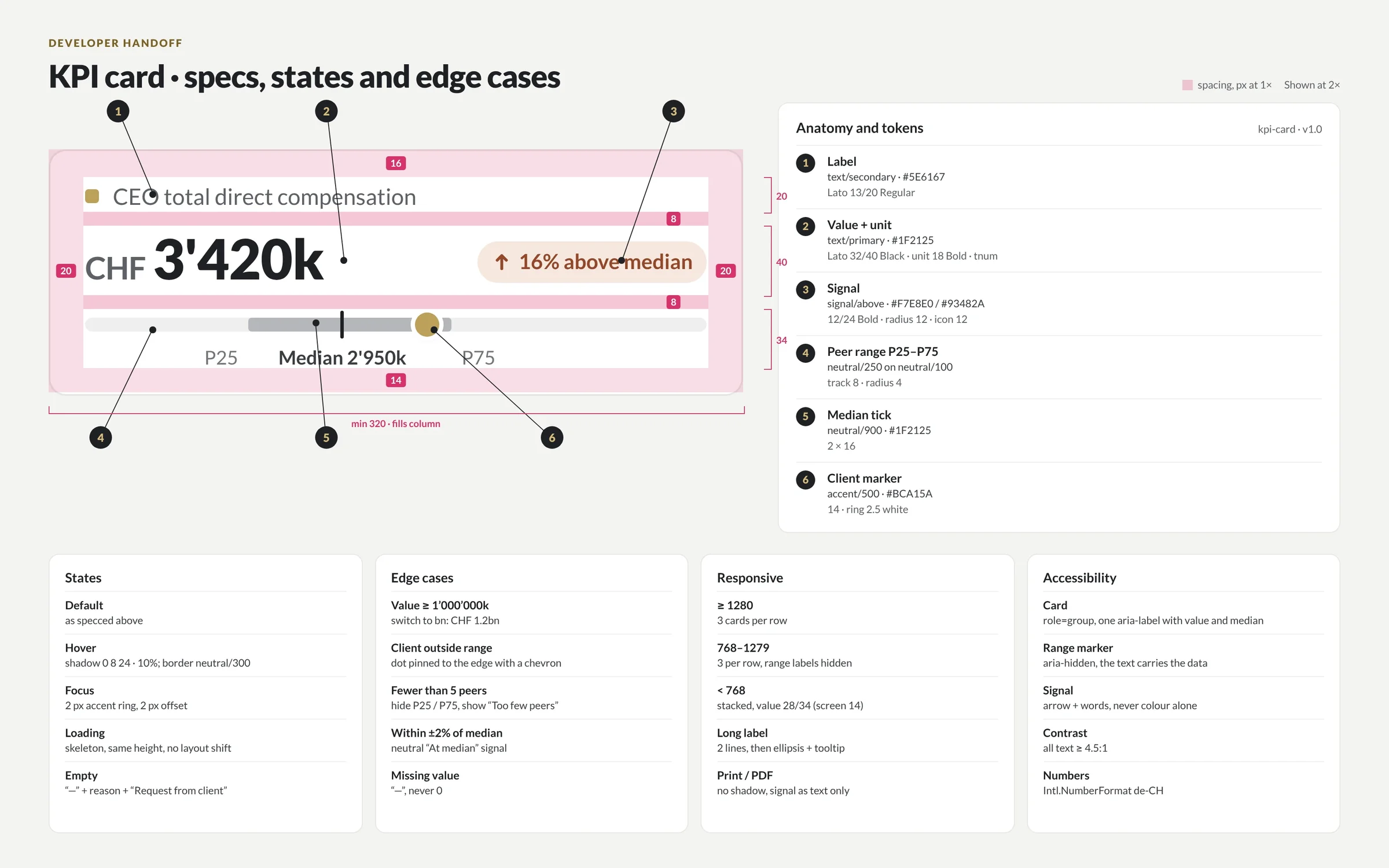
Every state and edge case designed up front, because HCM’s own developers built what we drew.
An executive pay reporting platform, built from scratch.
We designed the platform from the first screen: reports, flows and every state, around the work consultants do for each client.
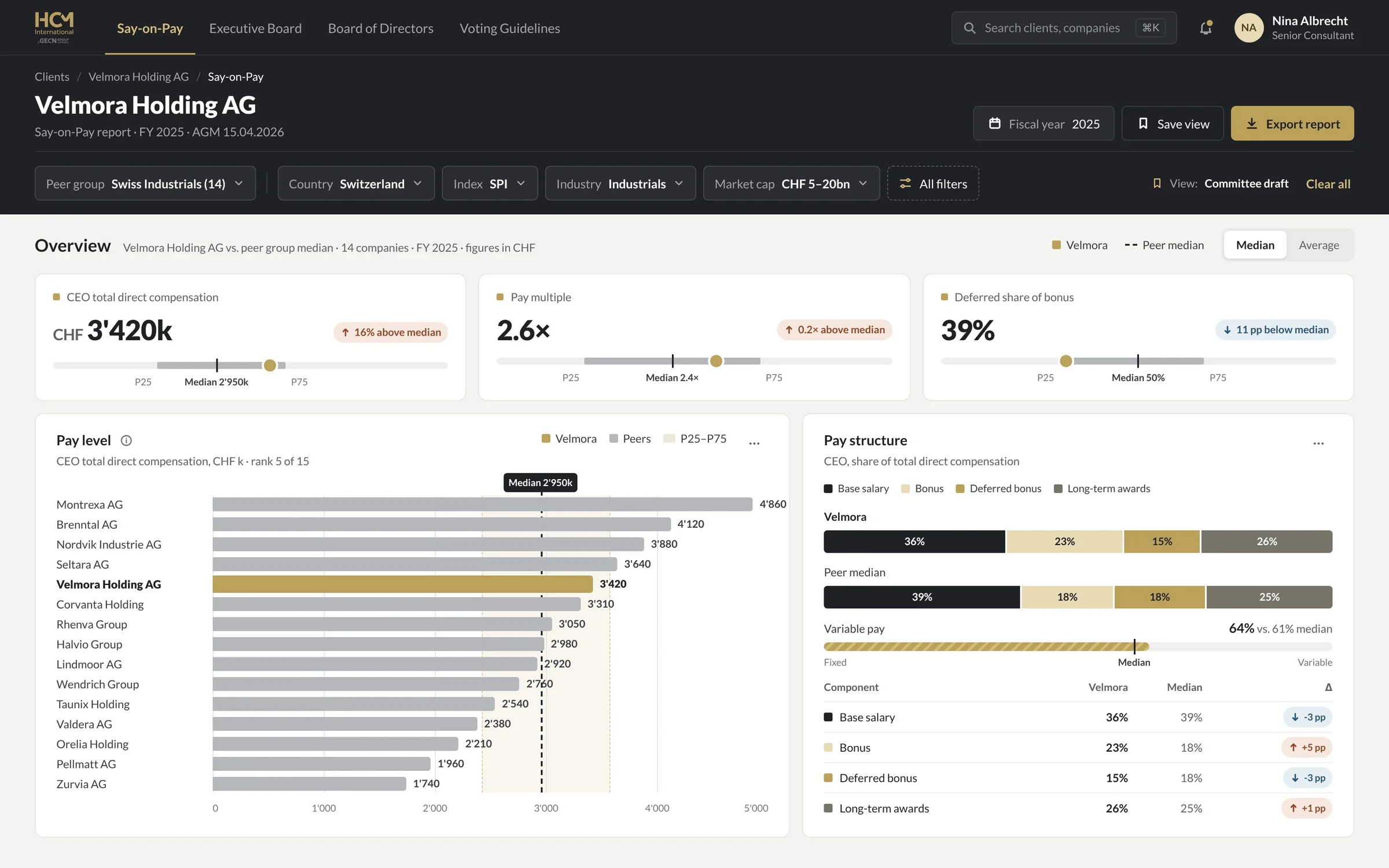
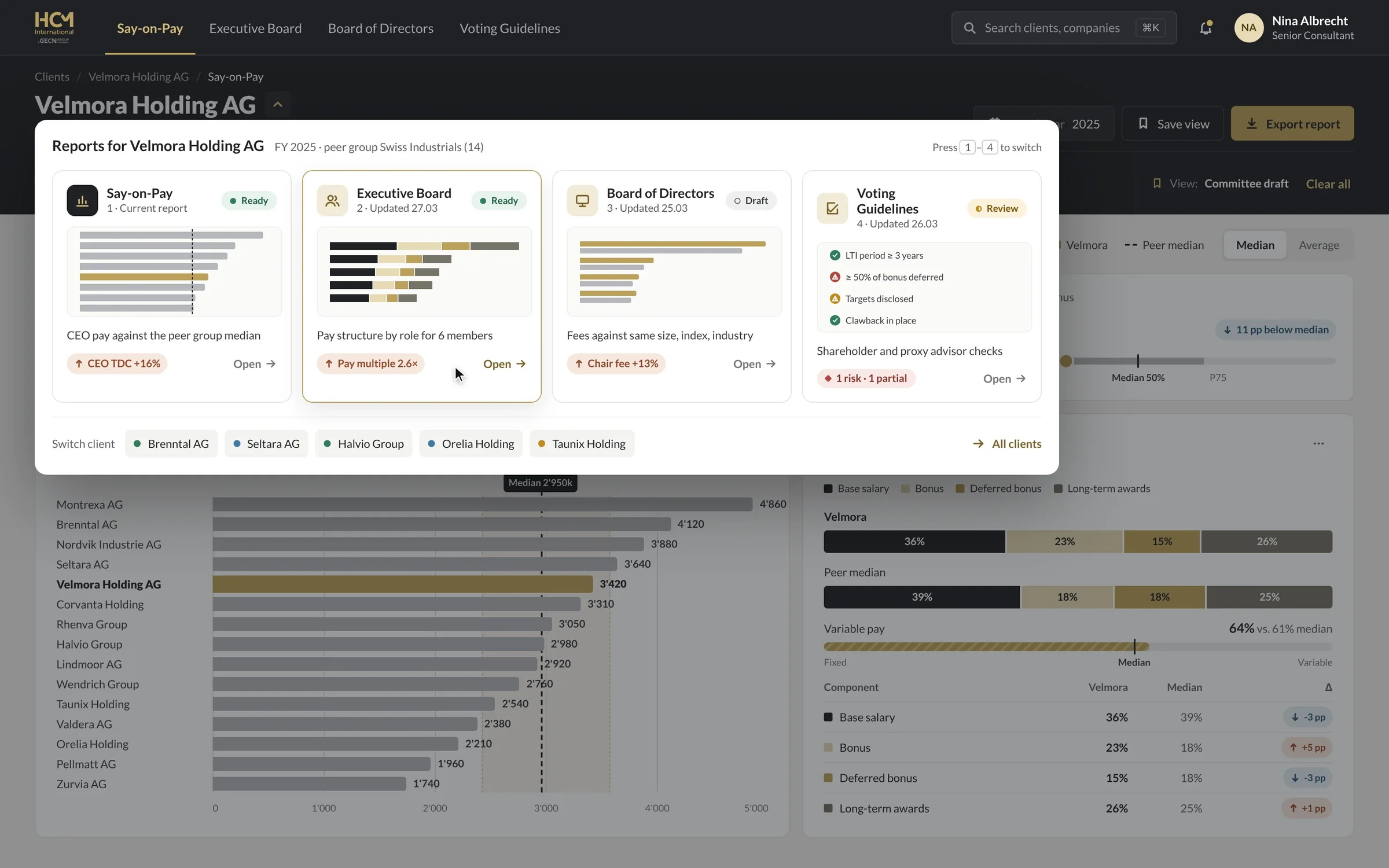
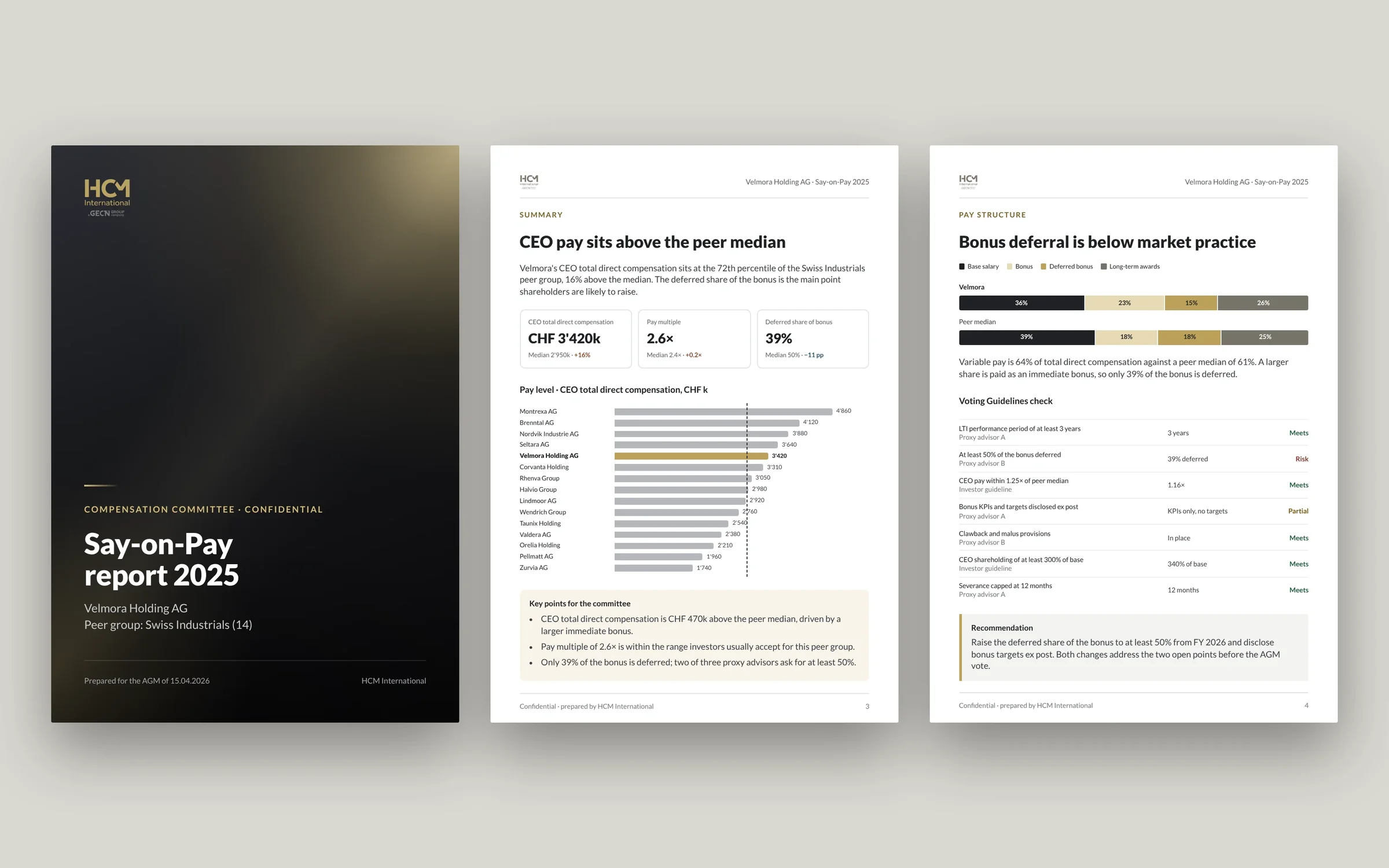
- Say-on-PayExecutive pay against a chosen peer group, ready for the shareholder vote.
- Executive BoardPay levels and structure for the executive team: base salary, bonus, deferred bonus and long-term awards.
- Board of DirectorsBoard fees compared with companies of the same size, index and industry.
- Voting GuidelinesWhat shareholders and proxy advisors look for, next to the client’s own numbers.
From data to a finished report in one flow
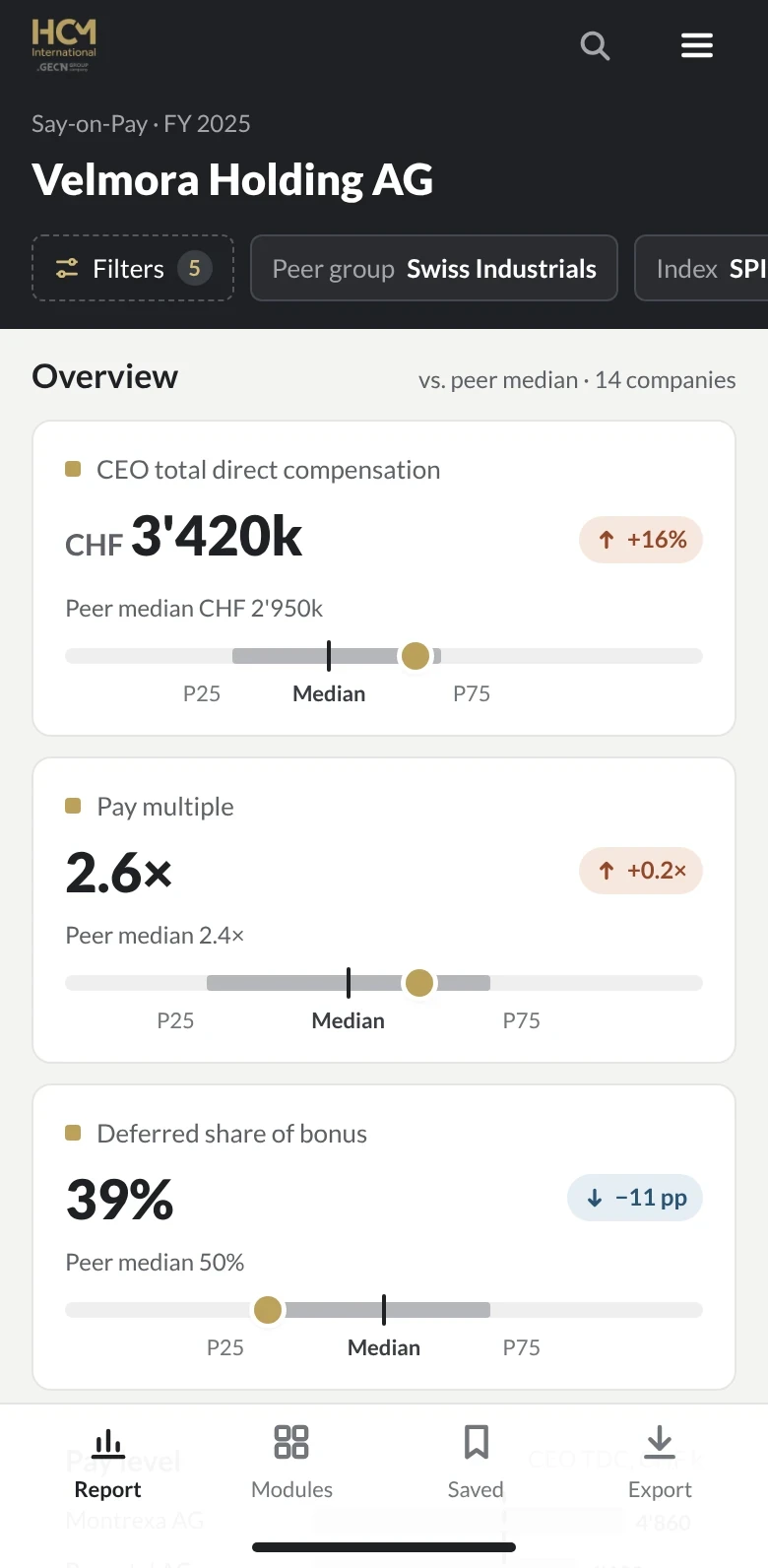
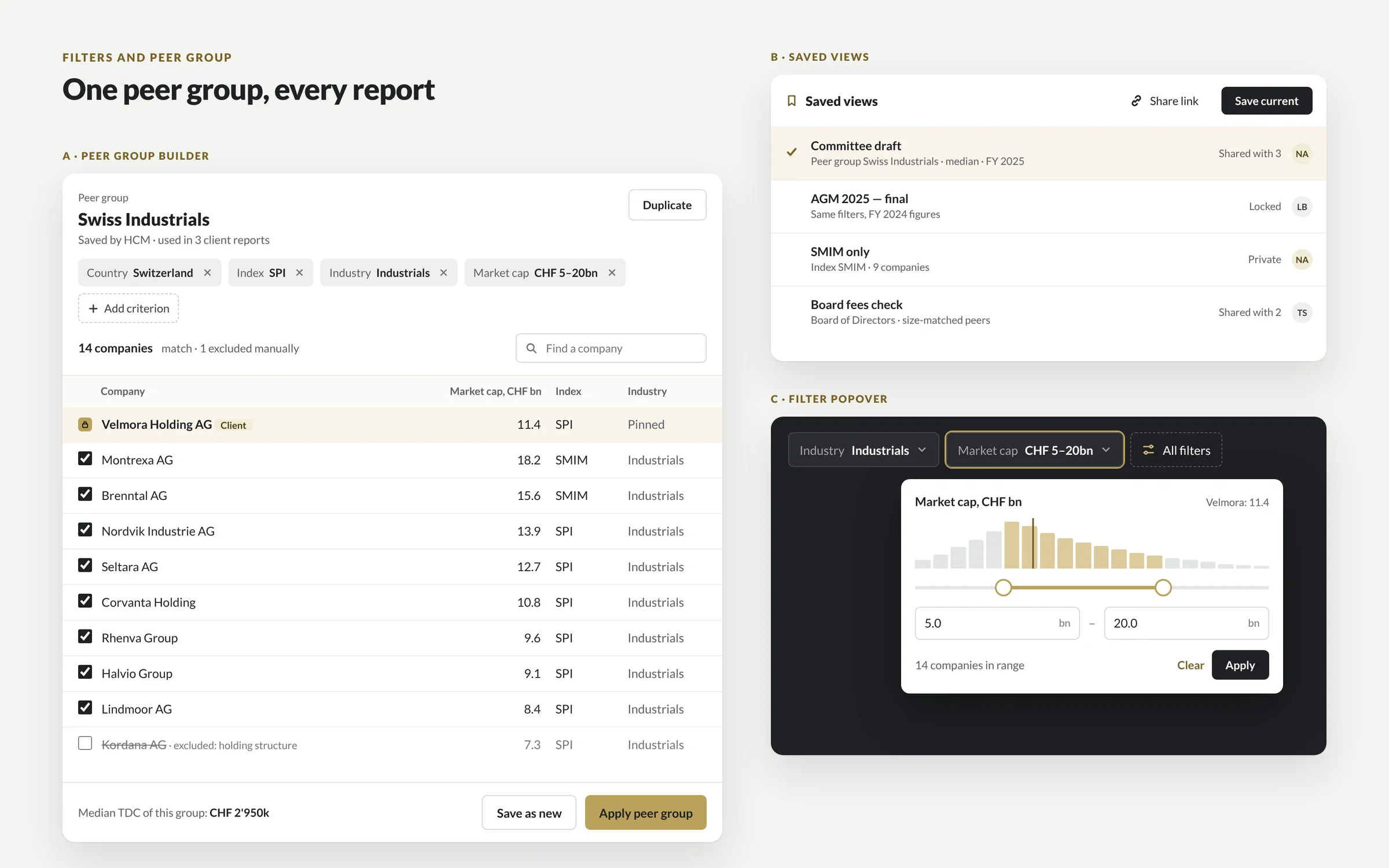
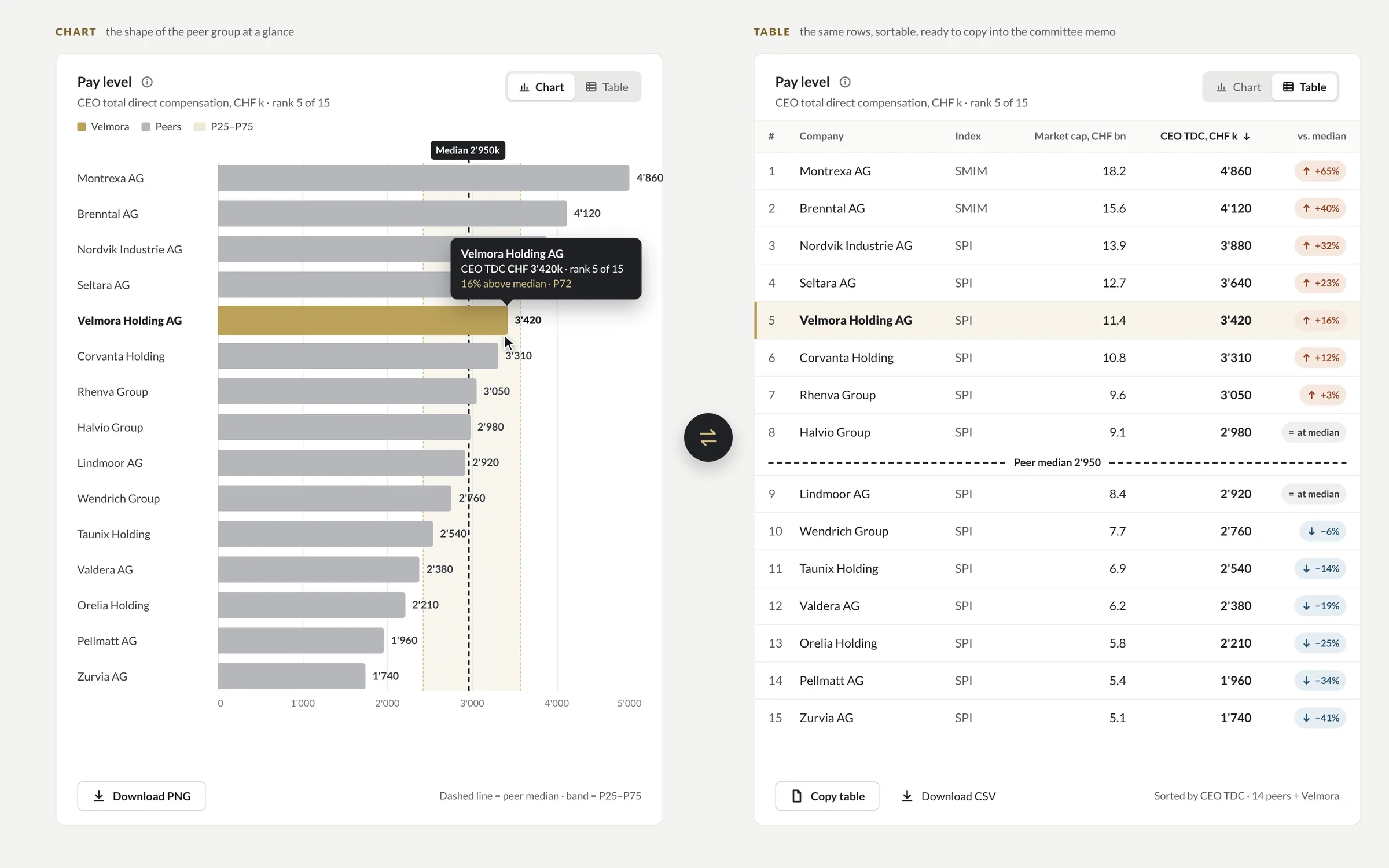
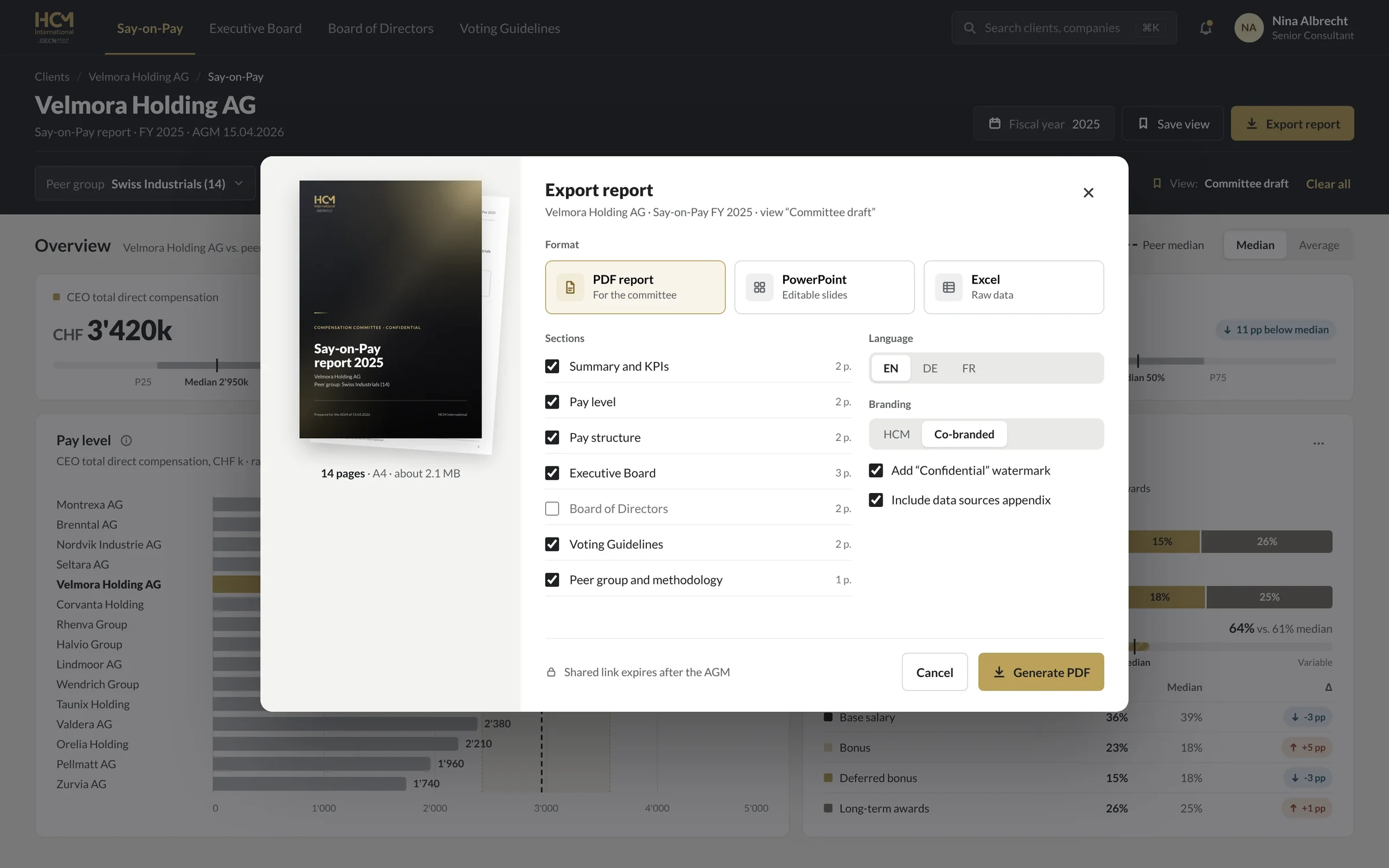
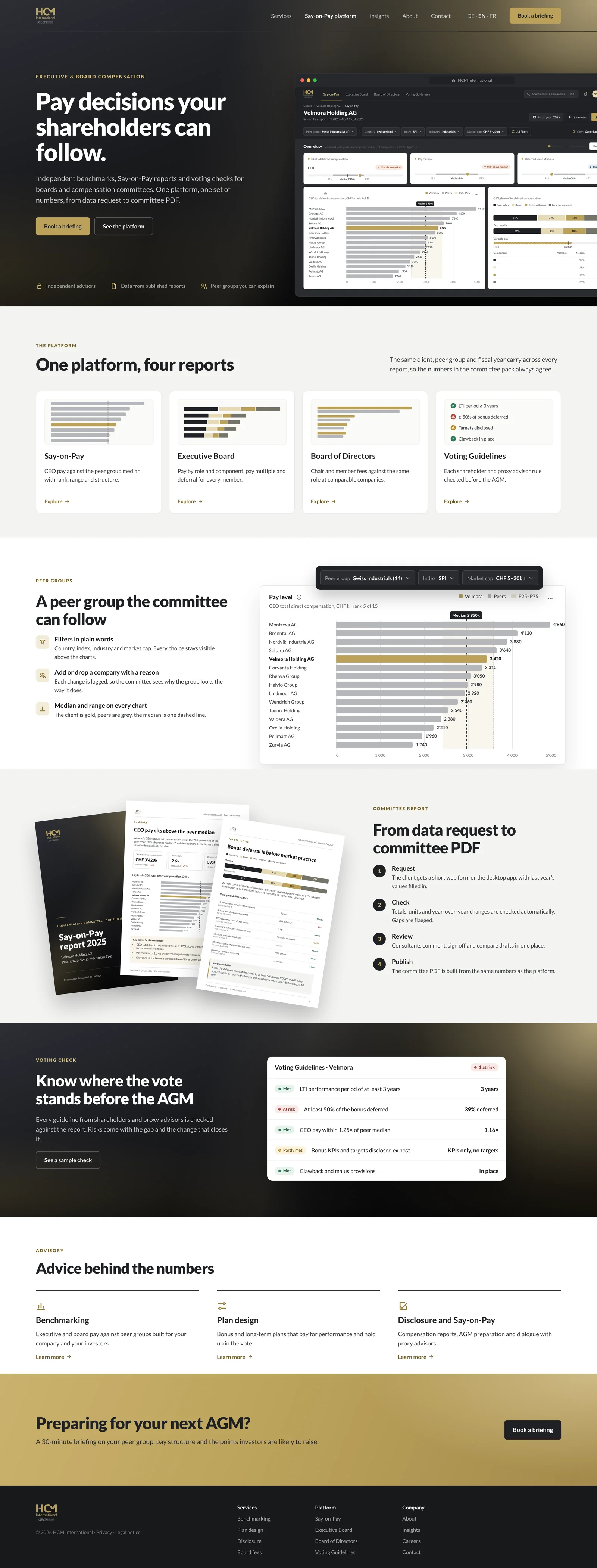
The core flow is the same in every report: pick the companies, compare, save the view, export the report for the committee.
- Filters for companies, peer groups, country, index, industry and market cap
- Saved views, so an analysis opens the way you left it
- Charts for pay level and pay structure, with a table view behind every chart
- Export of a finished report in one step
An internal app and a responsive platform.
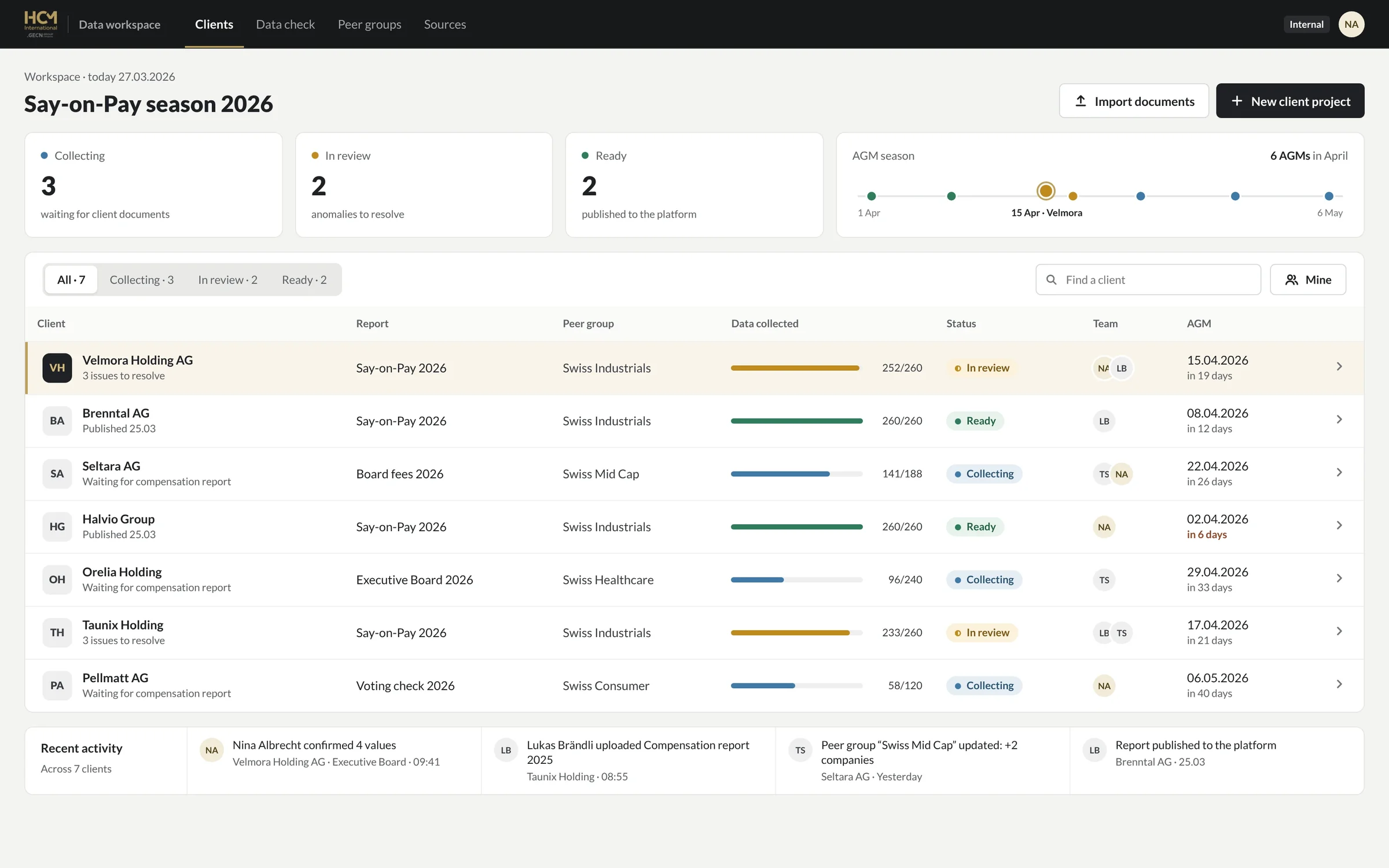
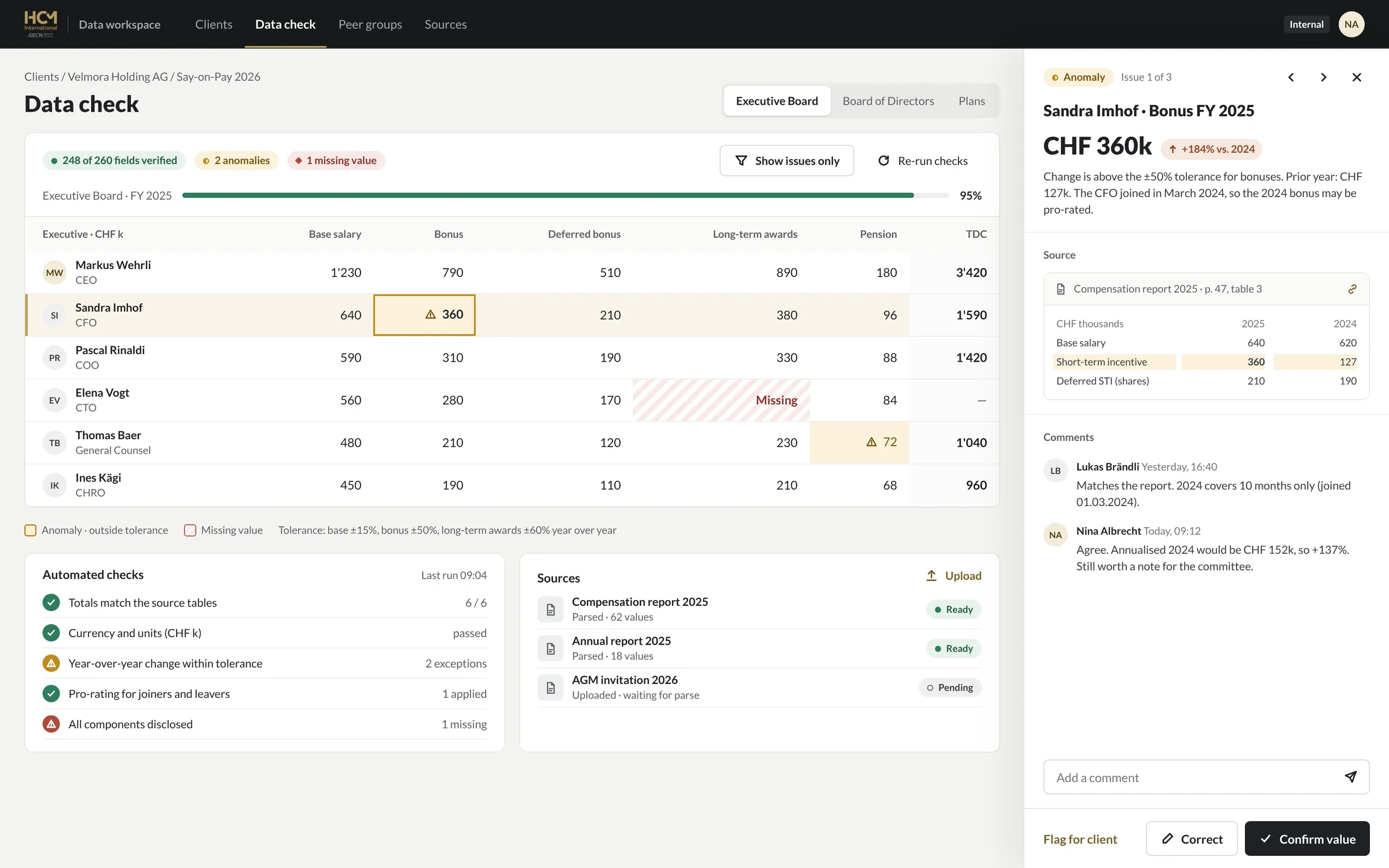
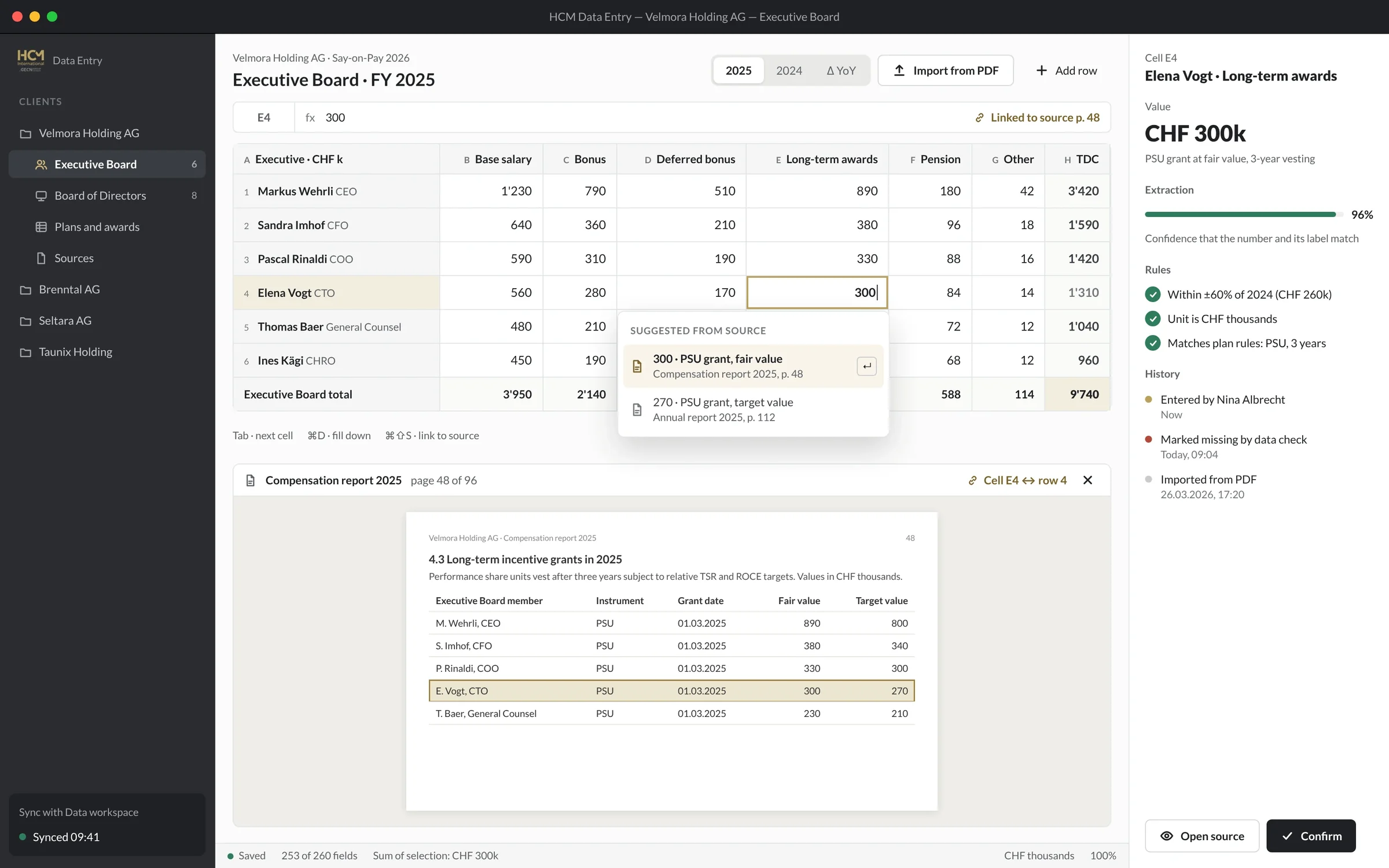
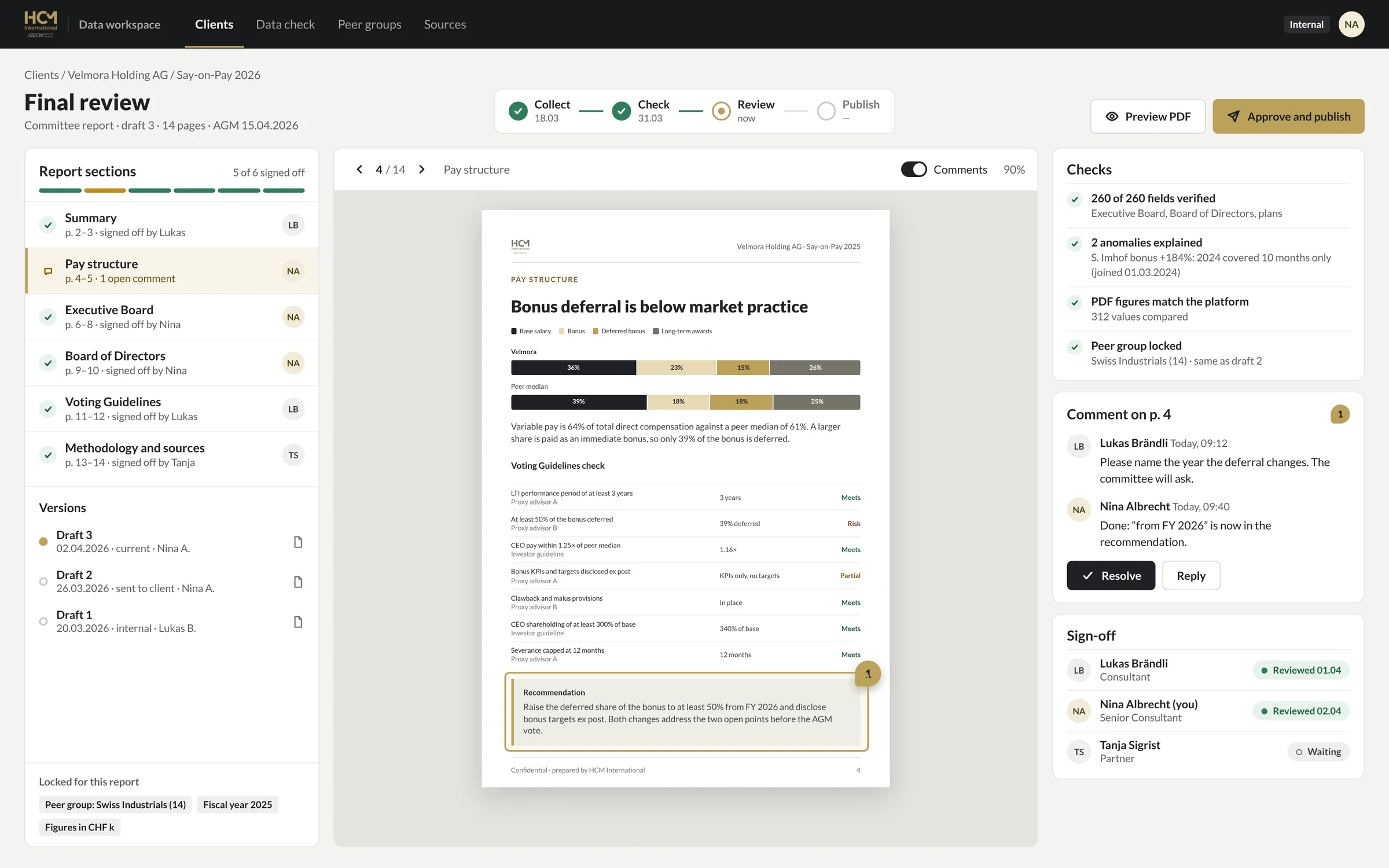
Where client data gets collected and checked
Every report starts with data. We designed HCM’s internal app, on the web and on desktop, where consultants collect each client’s compensation data and check it before it reaches a report.
- Built for consultants who work with the data all day
- Same components and data formats as the reporting platform
- One design system to maintain, not two
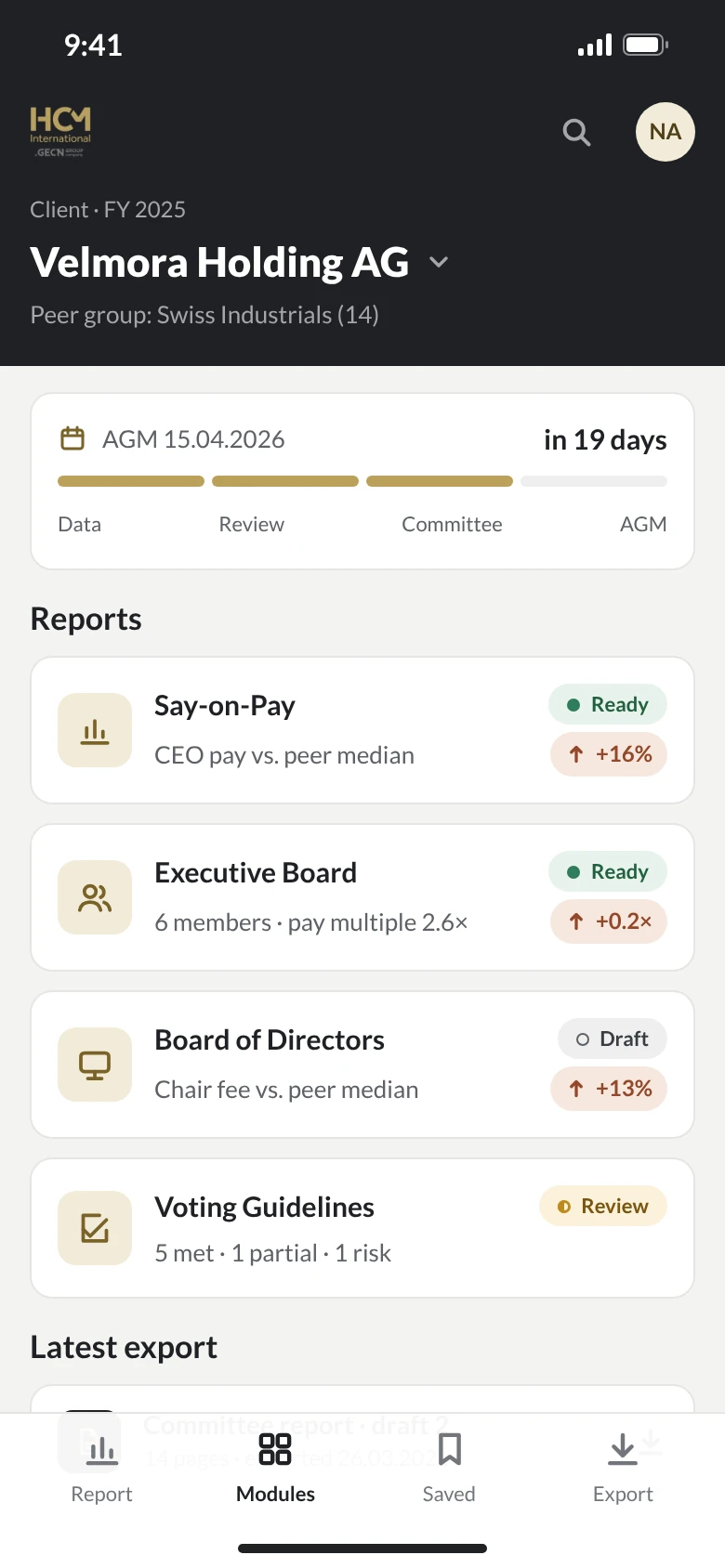
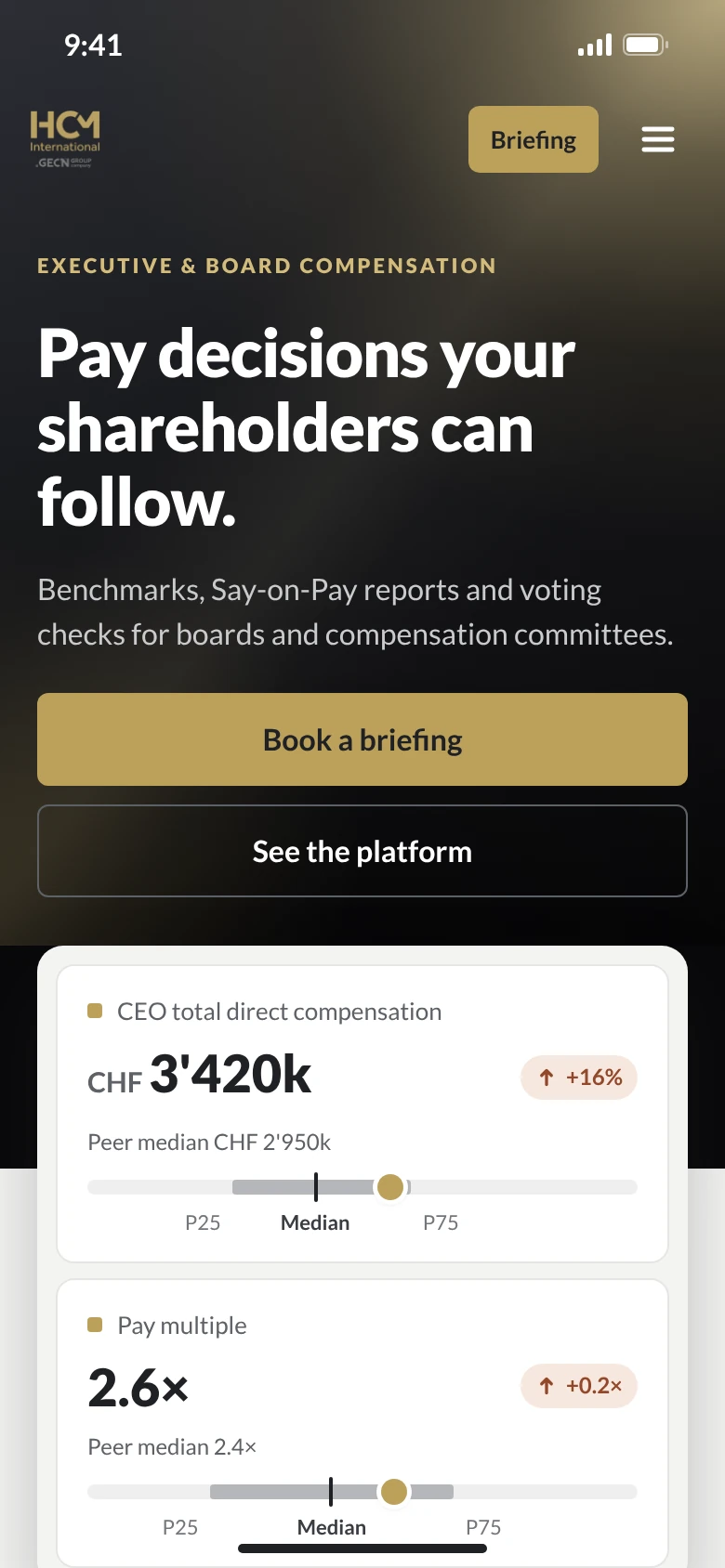
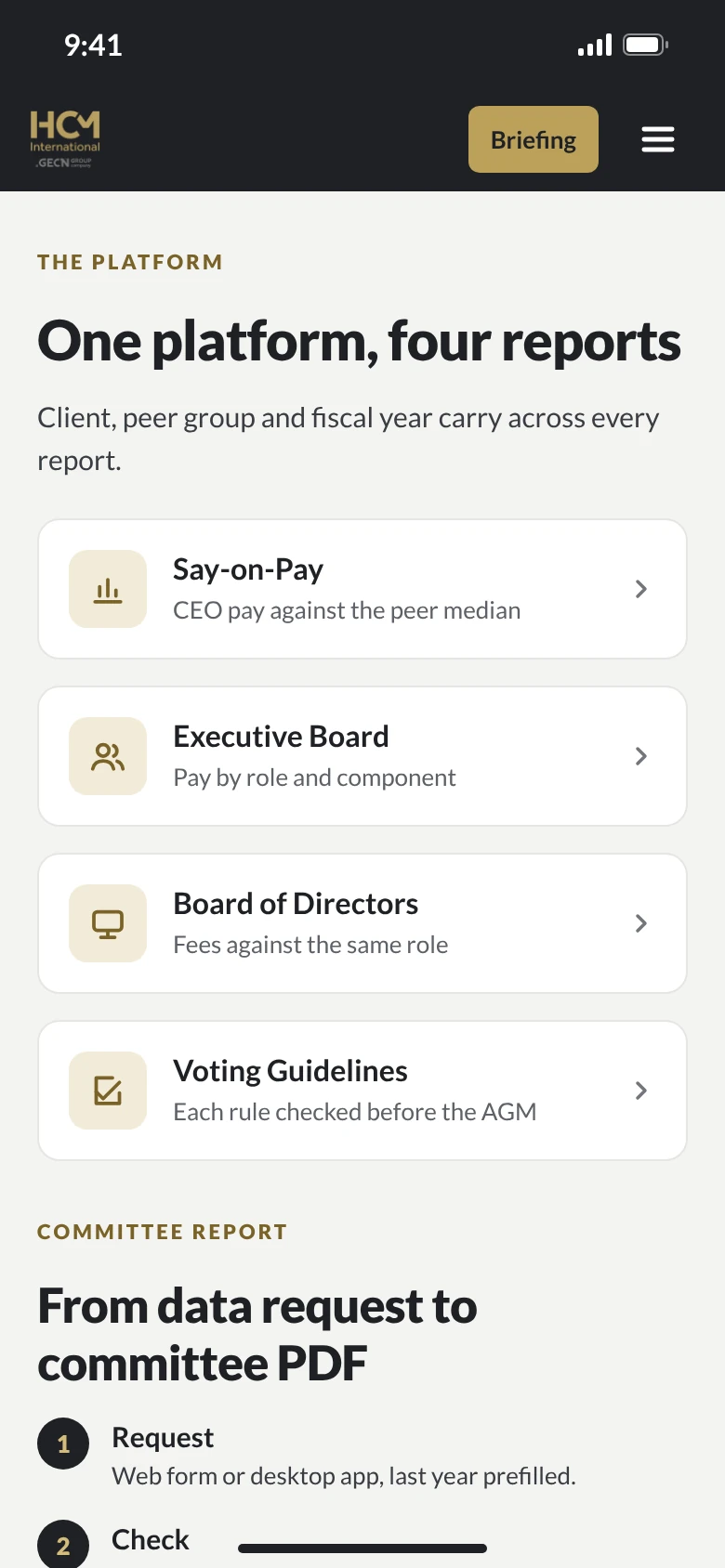
Reports that work on any screen
Not a separate app, but a serious adaptation: tables, charts and filters redesigned for small screens, so a report reads as clearly on a phone as on a laptop.
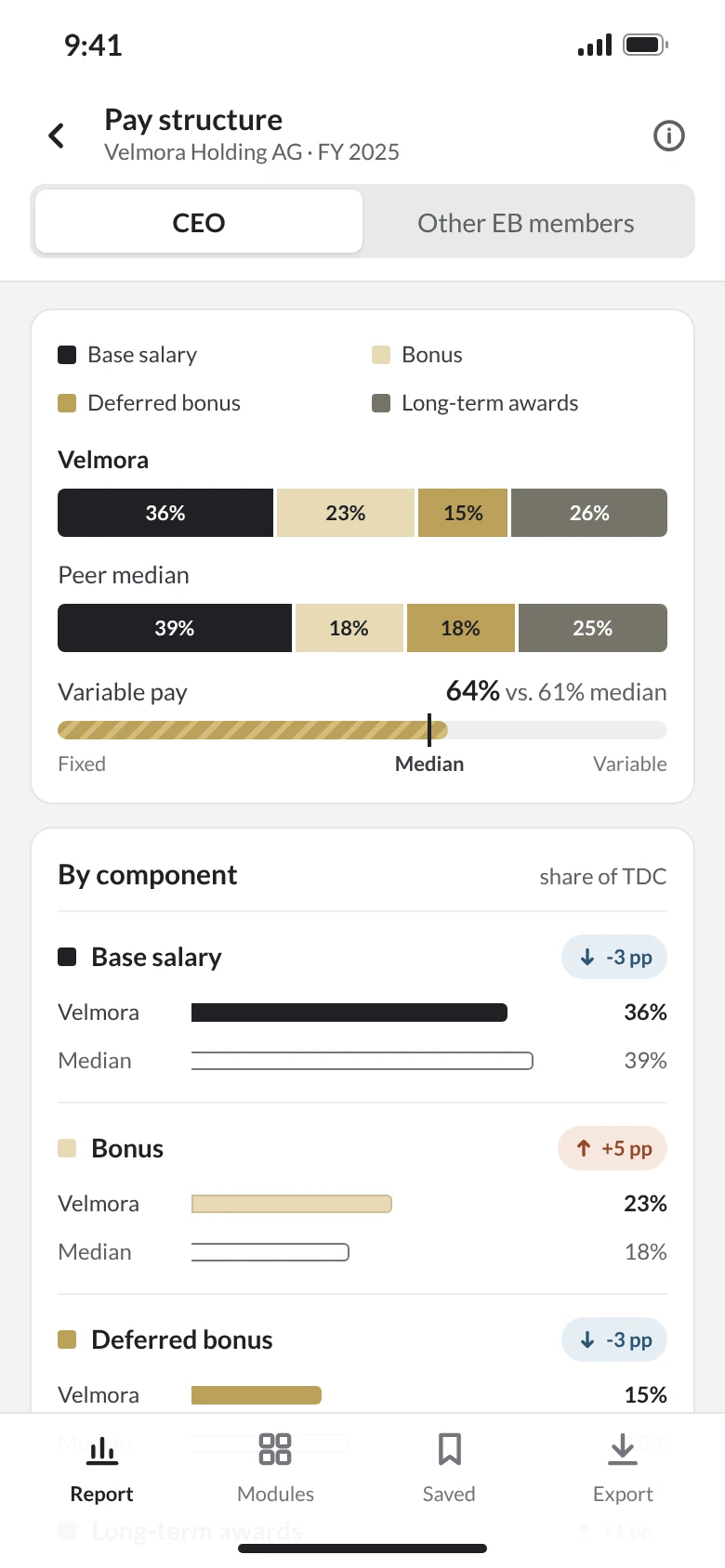
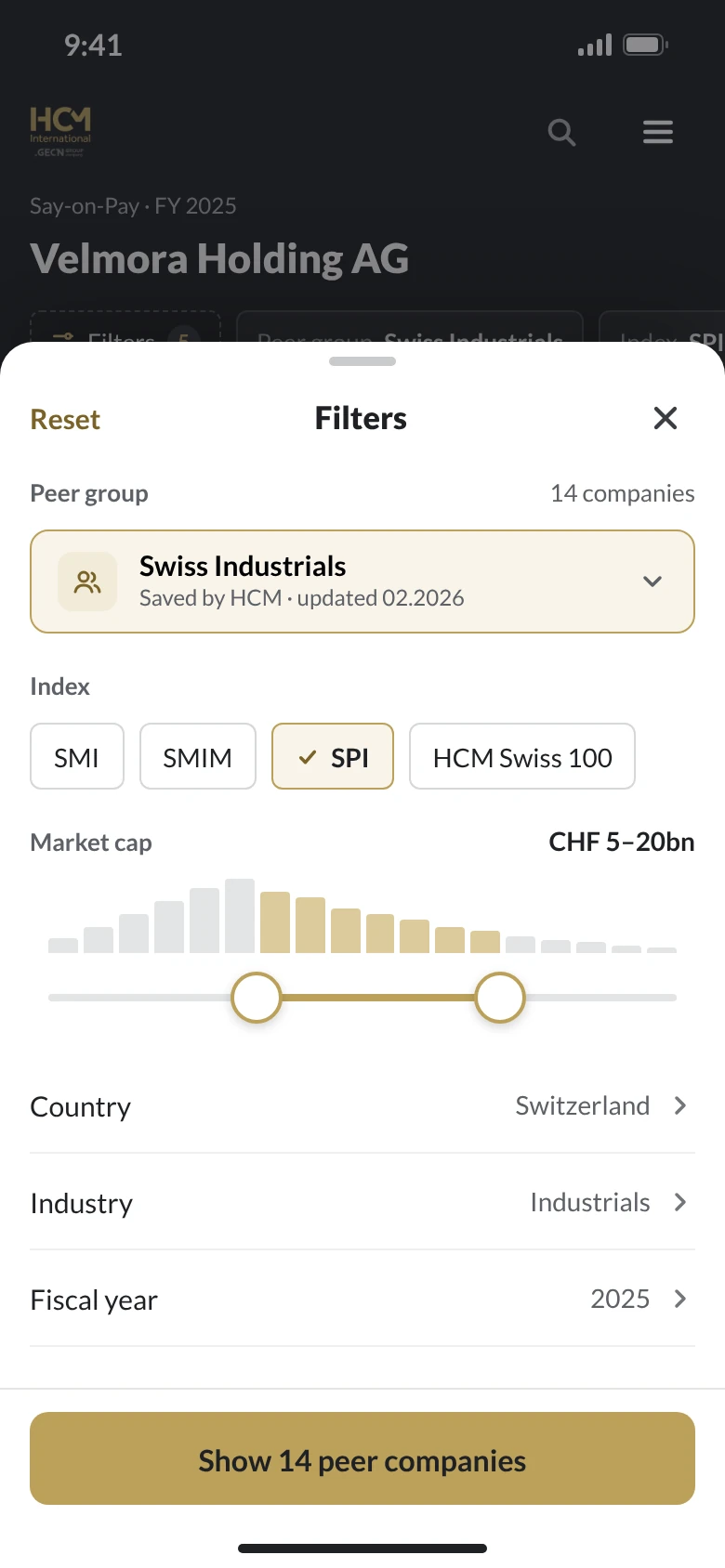
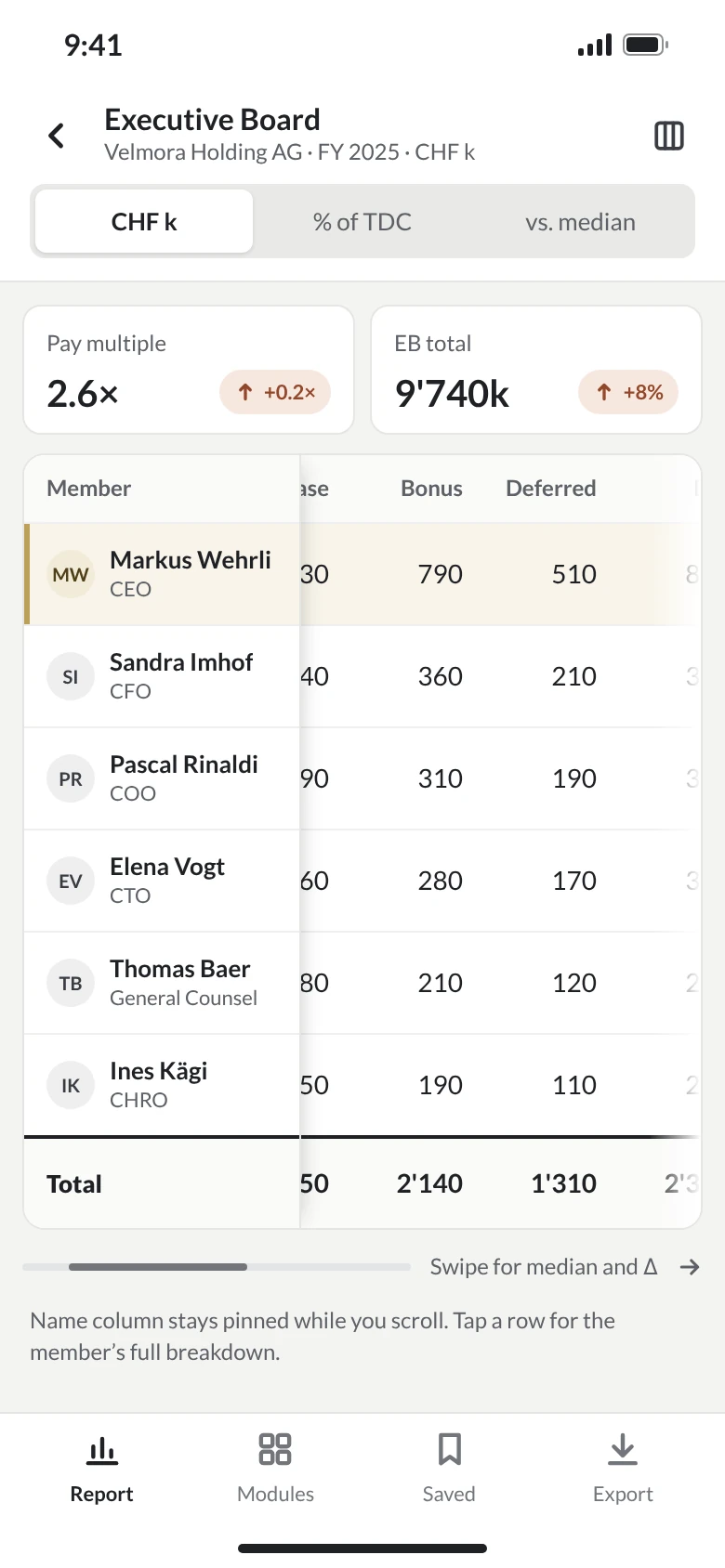
One system for every surface.
Shared tokens for color, type and data formats, and components built once for the reporting platform and the internal app.
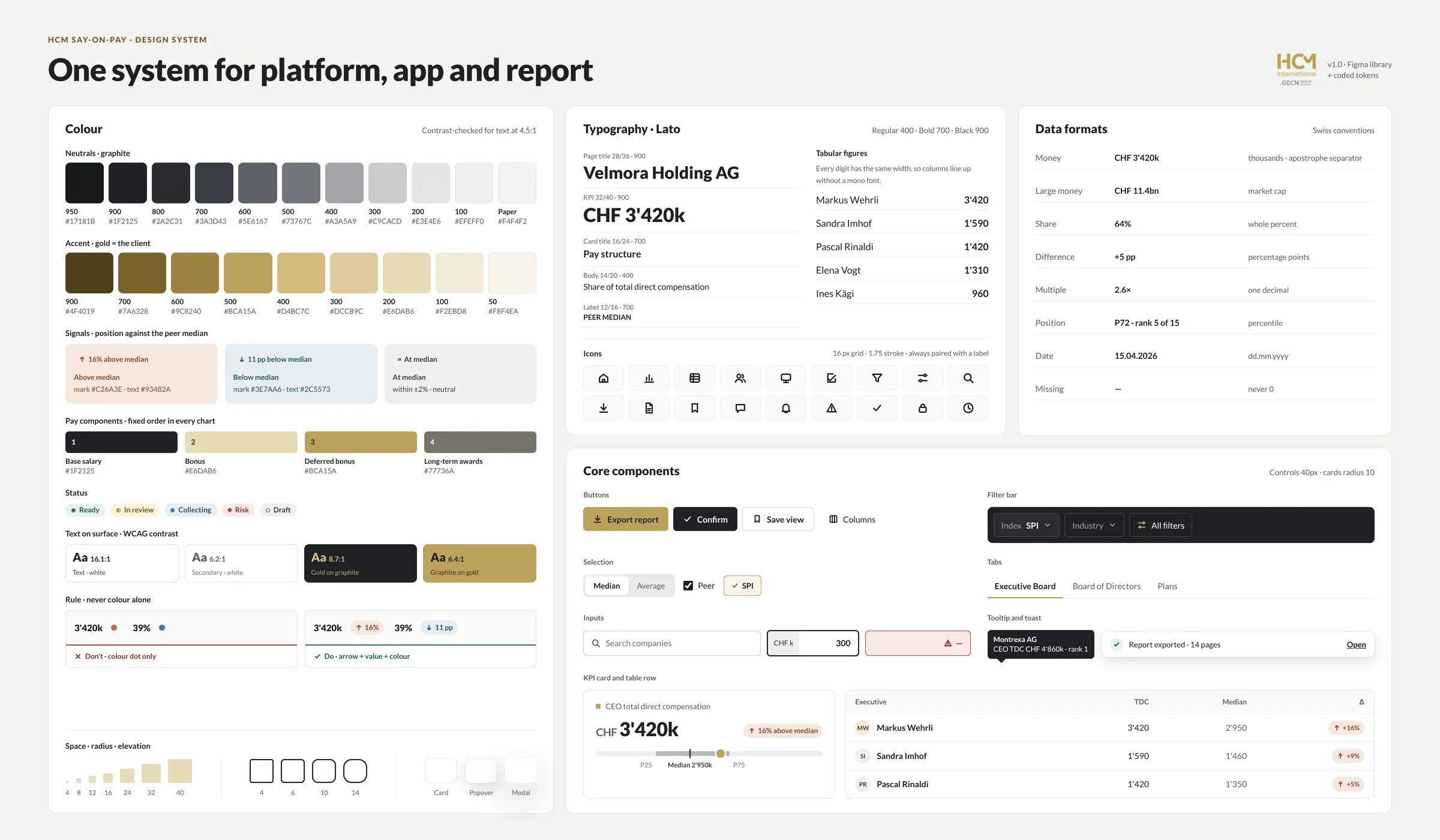
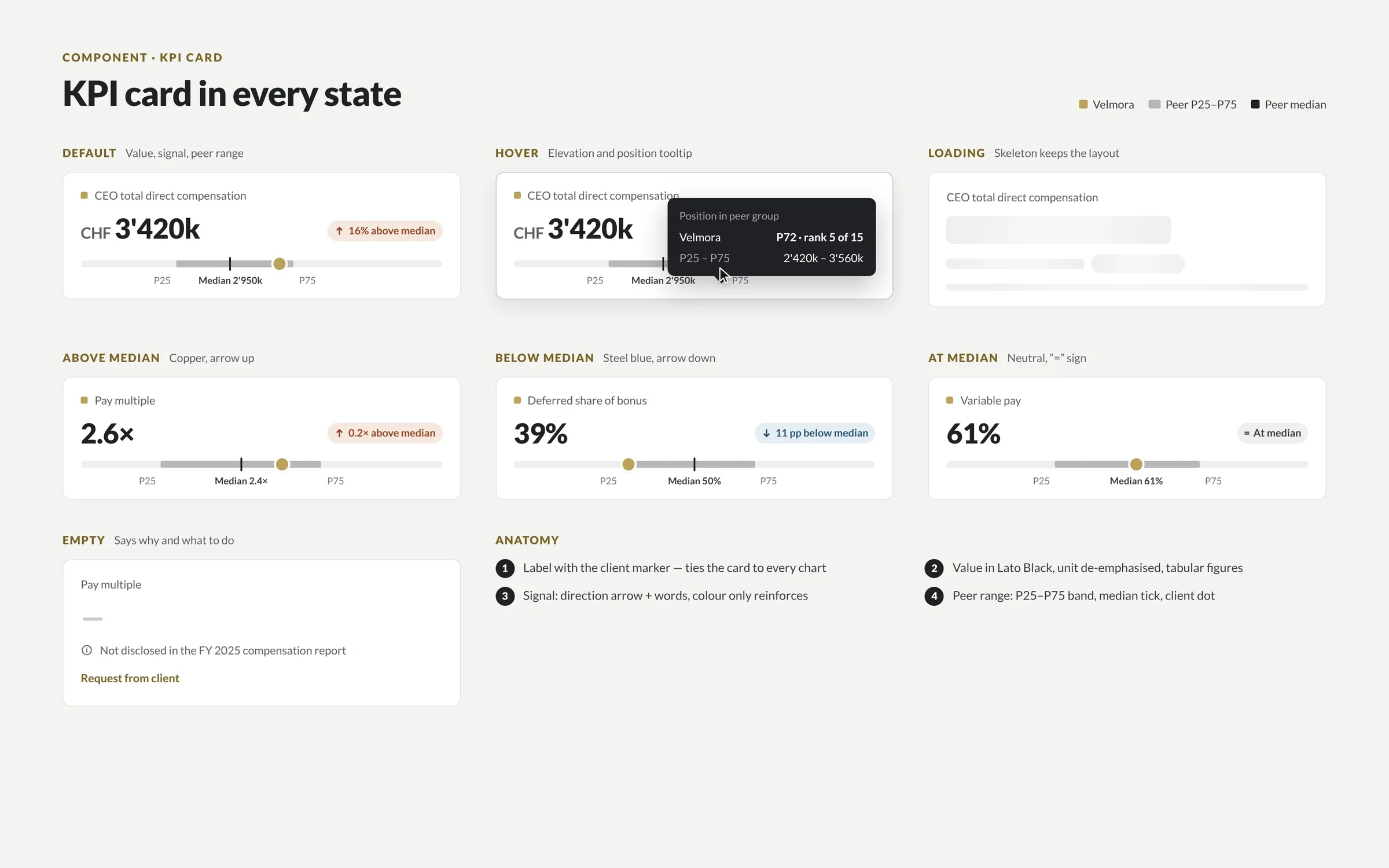
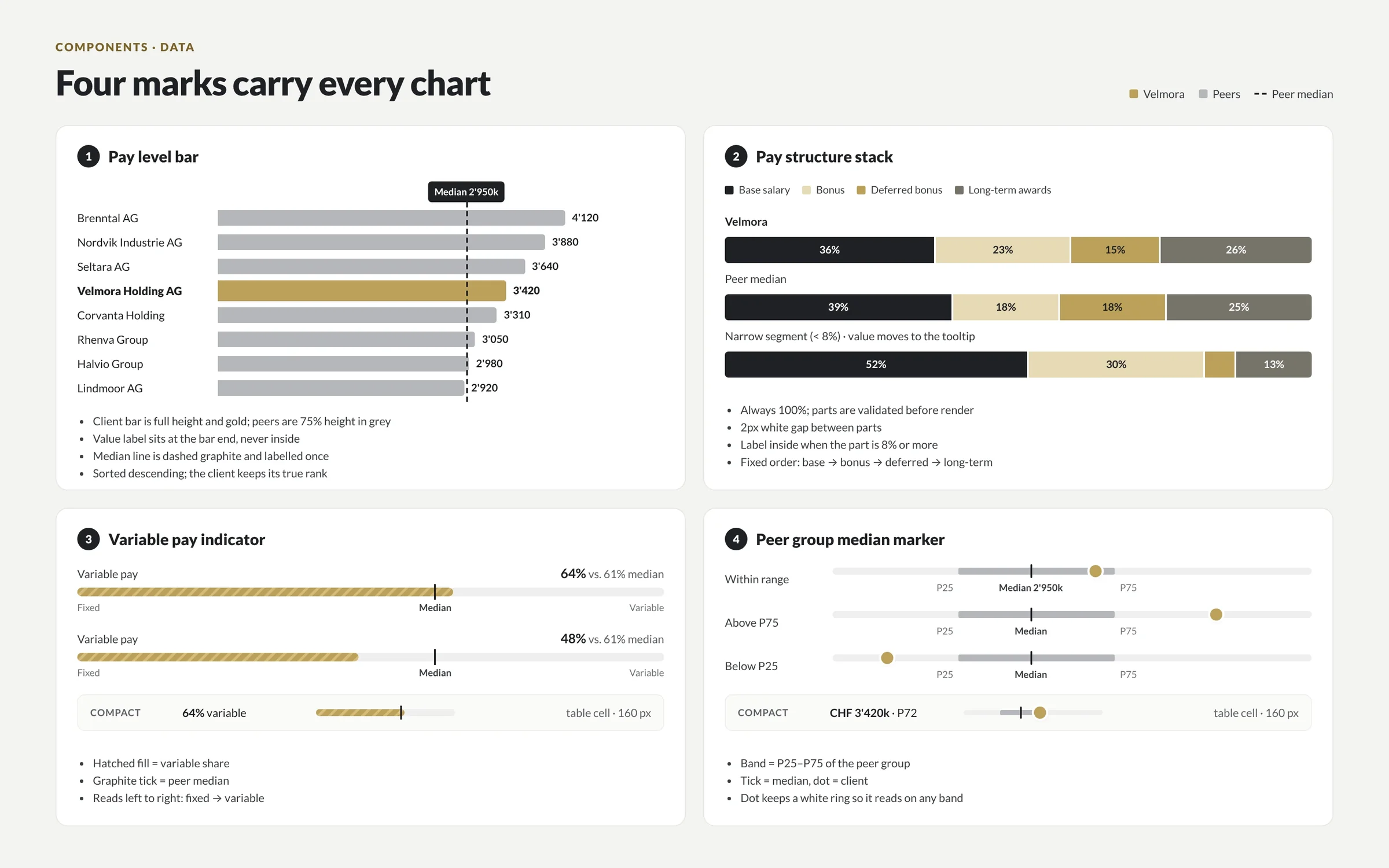
What’s shared and what’s per surface
| Layer | Reporting platform, internal app and responsive |
|---|---|
| Color and signal | Shared tokenNeutral surfaces, one accent, signal colors kept for above and below the peer median. |
| Type and numbers | Shared tokenOne type scale; tabular numbers so figures align in every table and chart. |
| Data formats | Shared tokenCurrency, thousands, percentages and pay multiples formatted the same way everywhere. |
| Charts and tables | Shared tokenThe same pay level, pay structure and table components in the platform and the internal app. |
| Layout and navigation | Per surfaceReports in the platform, a workspace in the internal app, a single-column flow on small screens. |
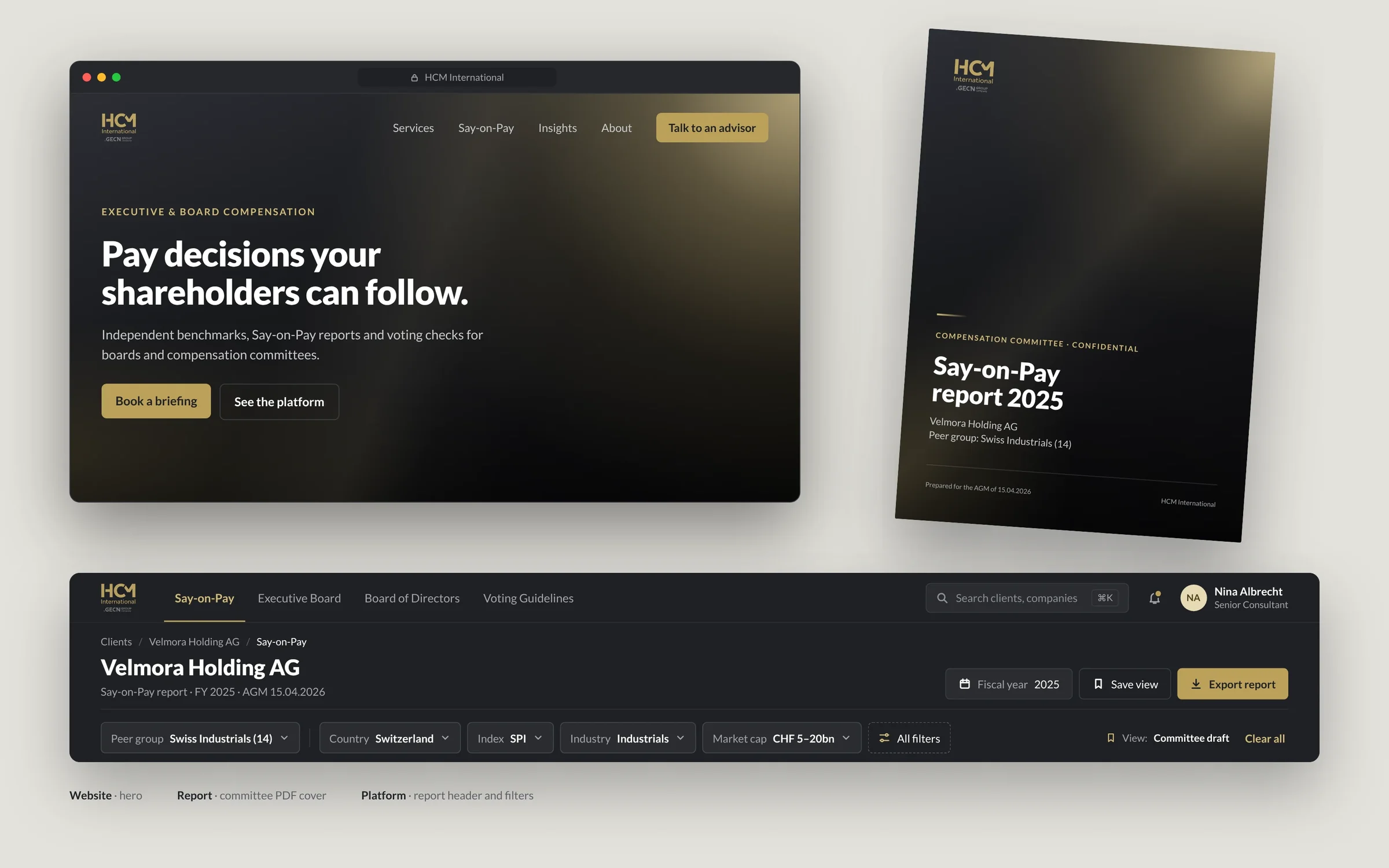
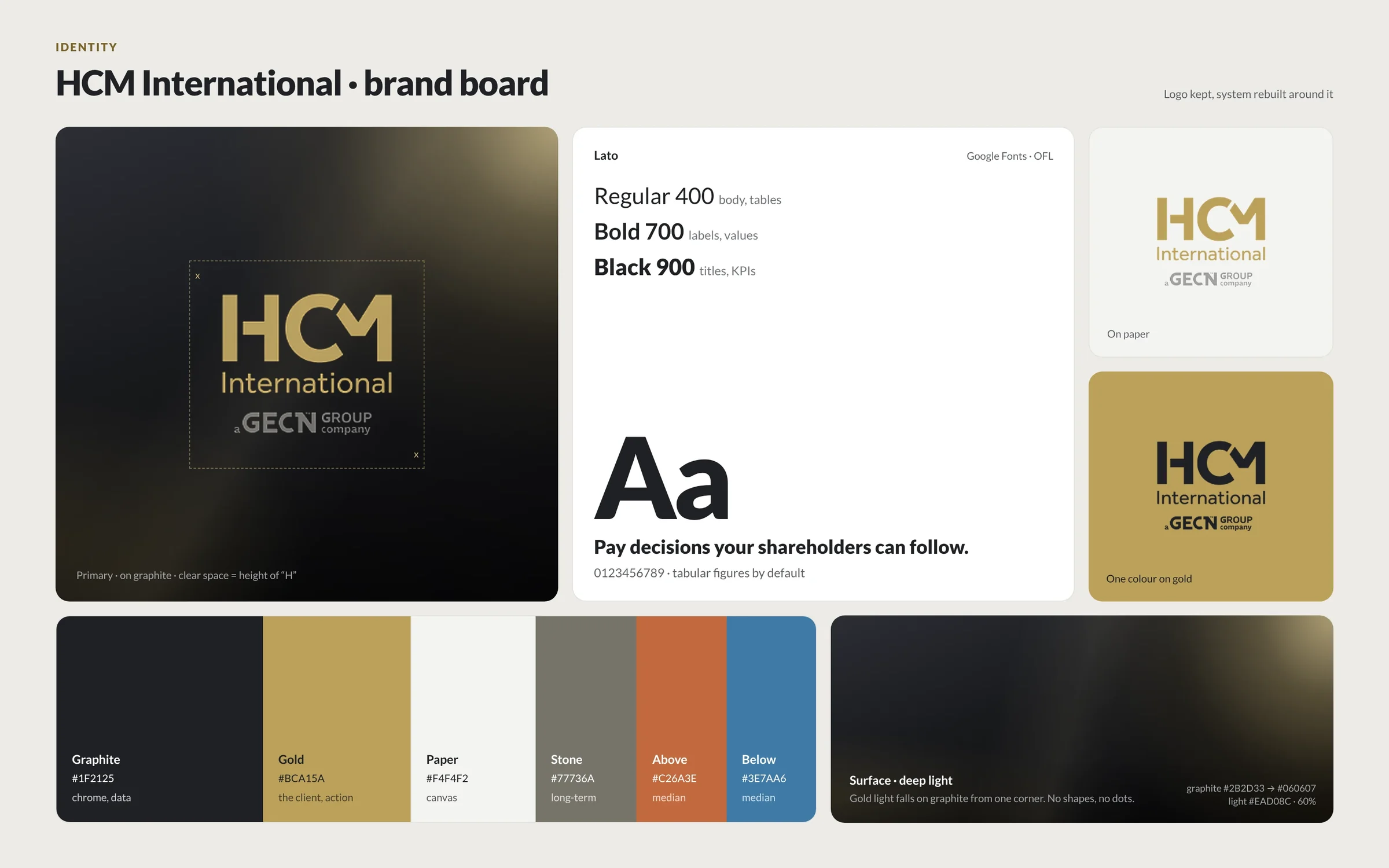
A brand as precise as the data
Alongside the product we designed HCM’s new identity and website, so the platform, the reports and hcm.com speak one visual language.
Same task, fewer steps.
Per client, per year: eight steps across four tools became four steps in one platform.
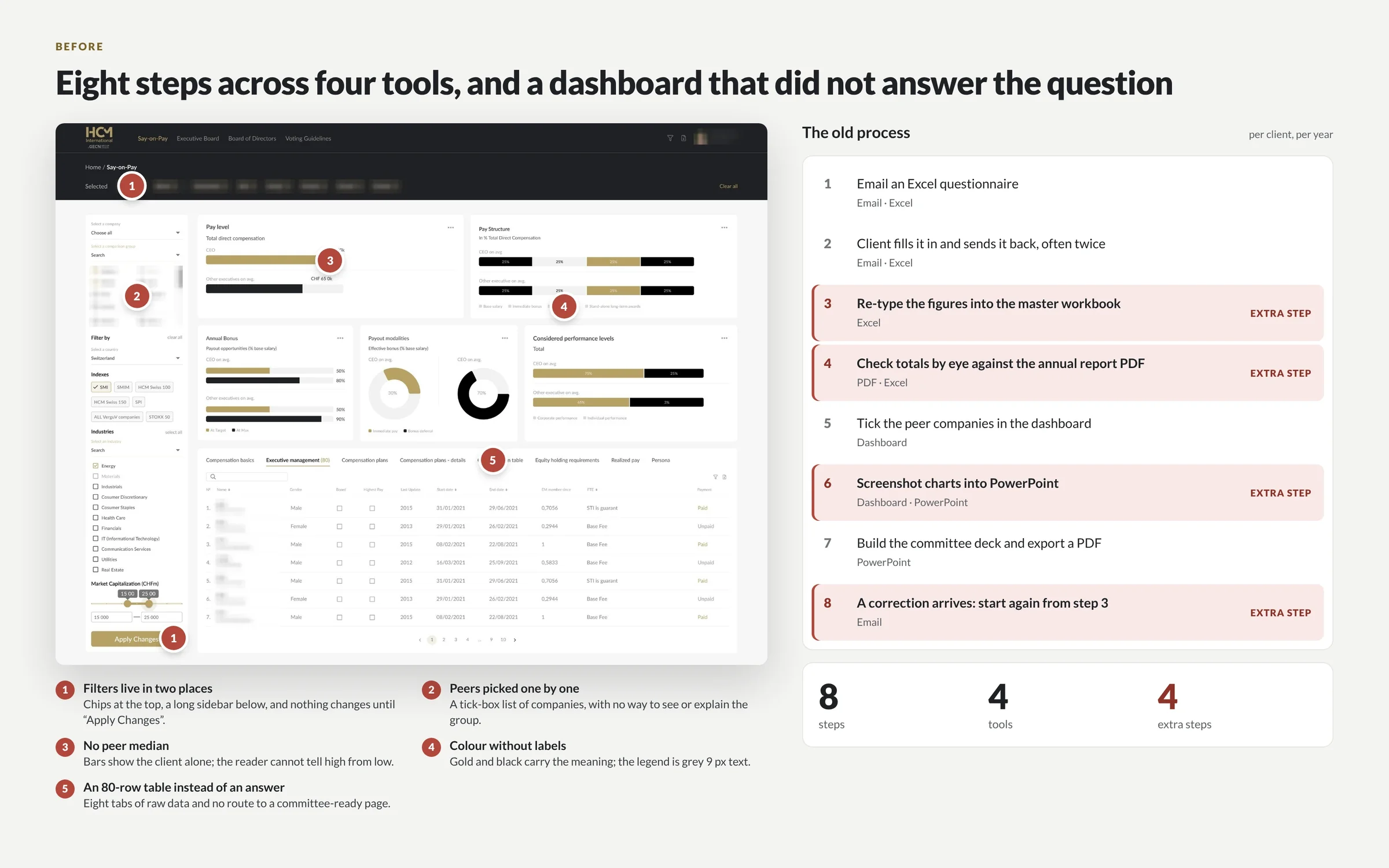
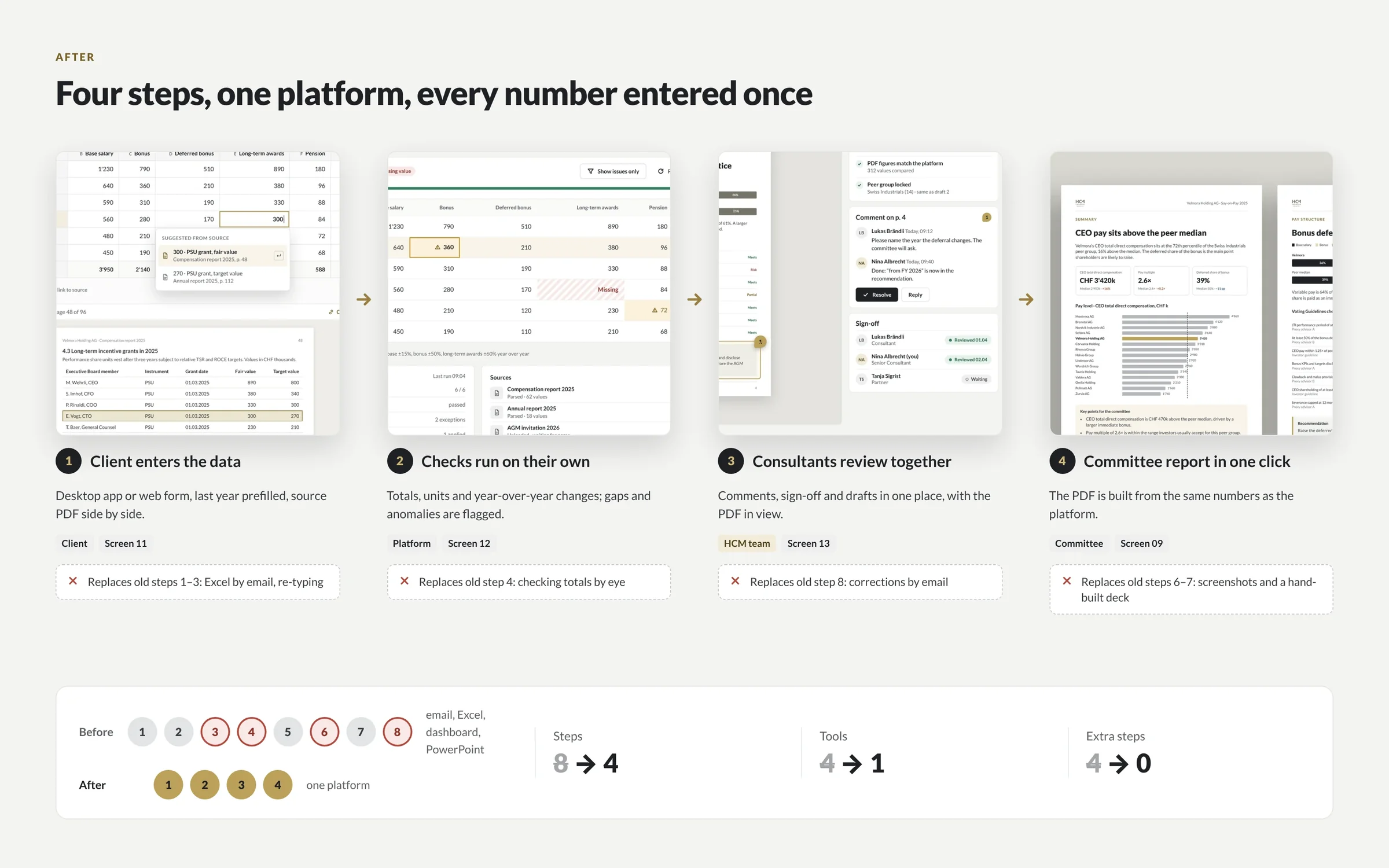
What changed after the relaunch.
“As we prepared for the relaunch, we needed to simplify a product that had become increasingly complex. Ignat helped improve clarity, streamline key workflows and create a much stronger experience for our users.”
Lessons for enterprise SaaS redesigns.
- Simplify the path, not the dataBoards need the depth. What they don’t need are extra steps between the question and the answer.
- Design the internal tools tooThe tool where consultants check data shapes every report clients get. One system for both keeps them consistent.
- When the client builds, the handoff is the productWith HCM’s own developers building, every state and edge case had to be designed, not left to guesswork.
Olga Beregova, Partner · HCM partners and consultants · HCM in-house development team
Two senior product designers: reporting platform, internal app, design system, identity and website
Sources: DIXI project records and case data · HCM International · SGMI, Stephan Hostettler · Schellenberg Wittmer, Swiss say-on-pay ordinance.
What did DIXI design for HCM International?
A reporting platform built from scratch with four reports (Say-on-Pay, Executive Board, Board of Directors and Voting Guidelines), an internal web and desktop app where consultants collect and check client data, a responsive version, one design system, and a new identity and website.
How long did the HCM redesign take?
5–6 months from the first audit to the relaunch. Two senior DIXI designers worked embedded with HCM’s partners, and HCM’s in-house developers built the product.
What changed after the relaunch?
22% more users now reach a finished report, the step where most of them used to drop off, and core tasks take 35% less time. The path from client data to a committee report went from eight steps across four tools to four steps in one platform. Absolute numbers stay confidential at HCM’s request.
How do you redesign a complex enterprise platform without losing depth?
Simplify the path, not the data. Each screen opens with the answer a board needs, keeps context such as the peer group always visible, and lets you drill into the numbers. Every state and edge case was designed up front.
Who built the HCM platform?
HCM’s own developers. We handed over specs, states, components and edge cases, and reviewed the build with them as they shipped it.
