


Mediator · Our own product · React Native
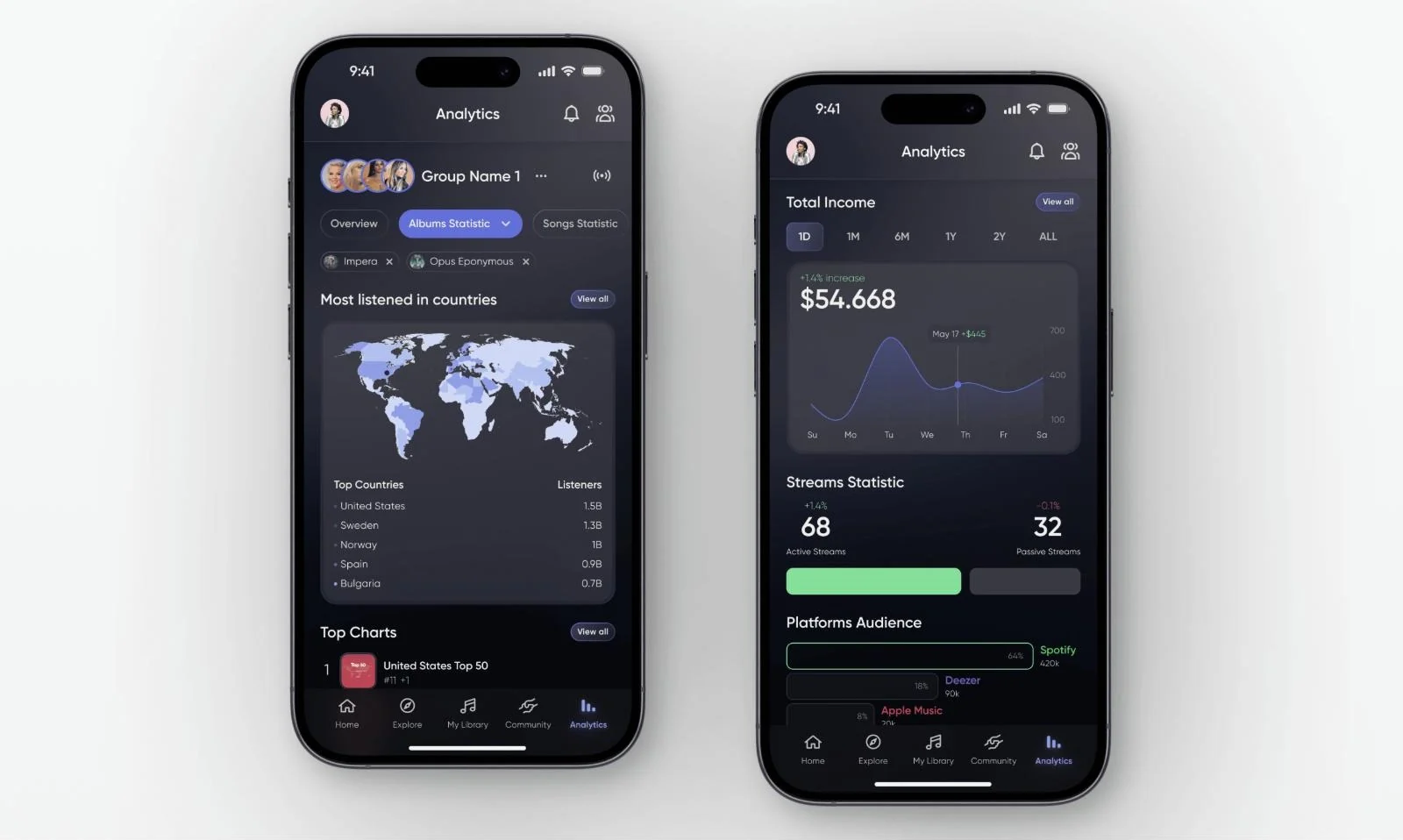
15+services in one app where labels and artists release music and track it everywhere. Designed, built and run by DIXI, on iOS and Android.
We design and build iOS and Android apps in React Native or in Swift and Kotlin, with the back end and payments they run on, and release them to the App Store and Google Play under your accounts. App design from $12k, apps from $28k, support from $1k a month.
 By Ignat, founder of DIXI · Updated
Designed and built by one team · code, store accounts and back end in your name

Mobile apps for startups and SaaS teams: consumer apps people open every day, companion apps for a web product, and first versions that need to reach both stores fast. We design the flows and the interface, build them in React Native or natively in Swift and Kotlin, connect the back end, and release the app to the App Store and Google Play. One team from the first screen to the store, and the code, the back end and the developer accounts are yours.
Daily habits, plans and progress: an onboarding that sets a goal in a minute and a home screen worth opening every morning.
The part of your product people need on the go, on the same account and data as the web app.
Several services behind one sign-in: uploads, payments, analytics and a community, designed as one system.
The smallest version that proves the idea, released to both stores in about 10–16 weeks and built to grow rather than be rewritten.
New iOS and Android versions, store policy changes, fixes and new features every month, by the people who built it.
Apps in React Native, or natively in Swift and Kotlin; Flutter when your team already writes it. Back ends on Supabase, Firebase or Node.js, designed in Figma.
 React Native
 Swift
 Kotlin
 Flutter
 React
 Supabase
 Firebase
 Figma
 Cloudflare
Because an app is judged twice: first by App Review, then by people deciding in their first session whether to keep it. Apple rejected 2,093,244 of the 9,100,620 submissions it reviewed in 2025, and 1,354,418 of those rejections were for performance: crashes, bugs and unfinished builds. When one team draws the screens and another builds them, this is where the gaps open.
Screens drawn at one size, with no empty, loading, error or offline state, so developers guess.
Instead: every state designed, on a small and a large phone, in light and dark mode.
Web patterns on a phone: small targets, no gestures, navigation that fights the platform.
Instead: iOS and Android conventions where they matter, one design system for both.
Missing privacy details, no way to delete an account, or payments set up the wrong way stop a release for days.
Instead: the store checklist runs before the first submission, and we answer App Review.
A new iOS or Android version breaks a screen and nobody who knows the code is left.
Instead: support by the people who built it, from $1k a month.
Review figures from Apple’s 2025 App Store Transparency Report (published May 2026). Checked 3 November 2026.
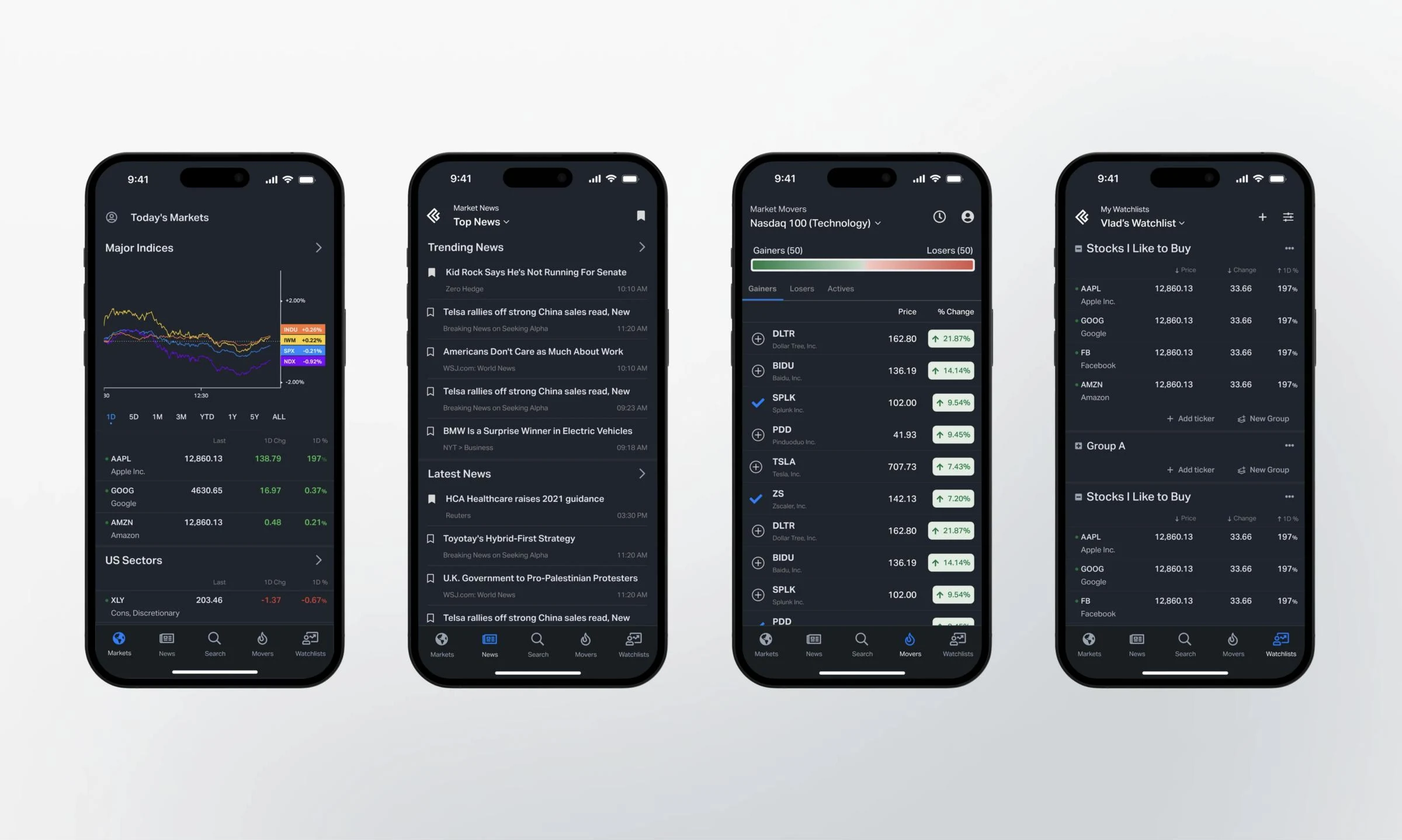
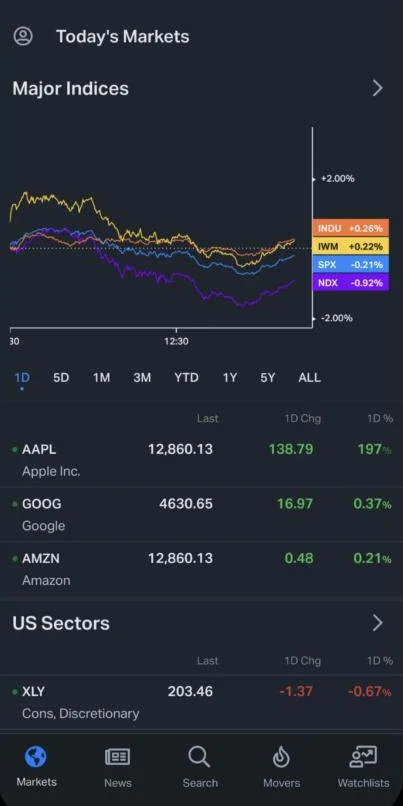
Mediator is our own product: a music distribution app for labels and artists that we designed, built and run, on iOS and Android from one React Native codebase. For Koyfin we designed the mobile app from the first screen; the platform has 500K+ users. BB Fit, an iOS fitness app in React Native, is in the studio now.
services in one app where labels and artists release music and track it everywhere. Designed, built and run by DIXI, on iOS and Android.
users on the platform. We designed its mobile app from the first screen, with a design system for web and mobile; Koyfin’s engineers built it.
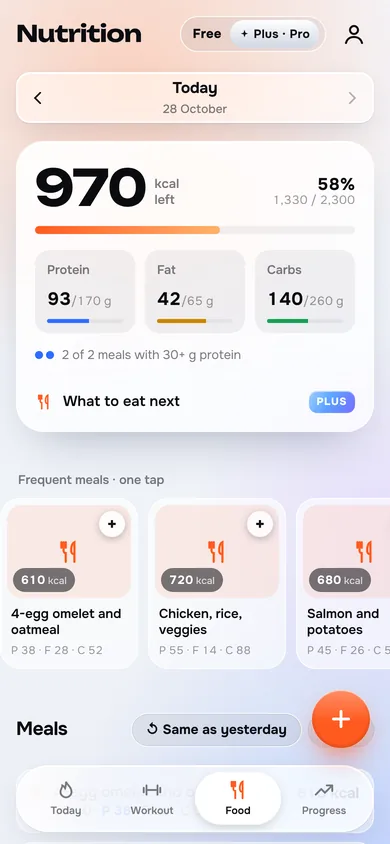
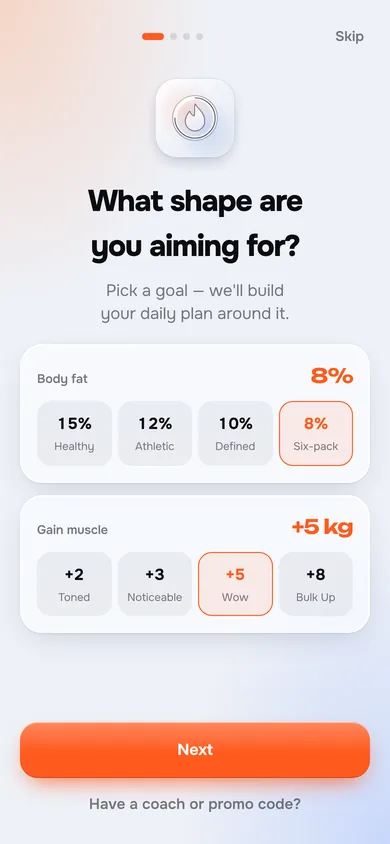
An iOS fitness app we are designing and building in React Native: a daily plan, workouts, AI food logging from a photo, progress photos and medals in one app. Onboarding asks for two things, a body-fat goal and how much muscle to gain, and builds the plan around them.
In development. The case study comes when it launches.

“DIXI helped us build a mobile app from the ground up and update the product. Their focus on user needs played an important role as we scaled to 500K+ users and expanded our subscription.”
Rich Meatto, Co-founder, Koyfin · $6M Seed
Client results are the work of each client’s whole team; the app was one part.
React Native for most apps: one codebase ships every feature to iOS and Android at once, and Netguru puts it at 60–70% of the cost of two native builds. Swift and Kotlin when the app leans on the phone itself or your engineers are native. Flutter when your team already writes it. Answer four questions for our starting point; the first call confirms it.
React NativeOne codebase for iOS and Android, so a feature ships to both stores at once. Our default when the value is in the flows and the data.
iPhone first? We still build both from one codebase and release Android when you are ready.Web app too? React and Next.js share the design system, the types and the back end with the React Native app.
Swift and KotlinTwo native apps, each in its platform’s own language, when the app leans on the camera, sensors, widgets or background work, or your engineers are native.
Web app too? We build it in React and Next.js on the same back end and design system.Two native apps cost more to build and keep up; we size both in the written plan.
Swift, iPhone firstA native iOS app first and Android once the idea is proven, for products whose buyers are mostly on iPhone and that lean on the device.
Web app too? We build it in React and Next.js on the same back end and design system.Plan the Android version from the start, so the design system already covers it.
FlutterYour team already writes Flutter, so we design for it and build alongside your engineers, in their codebase and their review process.
Web app too? Flutter can run in the browser, but a marketing site or a dashboard is usually better in React or Astro.We follow your team’s conventions instead of bringing ours.
Cost share from Netguru’s mobile app cost guide (updated August 2026). Checked 3 November 2026.
Every app we release is checked against the same list: touch targets and text that work for everyone, every state designed, crash and freeze rates under Google Play’s limits, the privacy details and account deletion App Review asks for, and analytics and crash reports live before launch. The table lists each check, the target and where the target comes from.
| Check | Target | Source |
|---|---|---|
| Touch targets | At least 44 × 44 pt on iOS and 48 × 48 dp on Android | Apple, Human Interface Guidelines; Android Accessibility Help |
| Text contrast | At least 4.5:1 for body text, in light and dark mode | W3C, WCAG 2.2, SC 1.4.3 |
| Larger text | Layouts hold up when people turn up the system text size | Apple, Human Interface Guidelines |
| Every state | Empty, loading, error and offline designed for each key screen | DIXI |
| Crash rate | Under 1.09% of daily users seeing a crash (Google Play’s bad-behaviour line) | Android Developers, Android vitals |
| Freezes (ANR) | Under 0.47% of daily users seeing “app not responding” | Android Developers, Android vitals |
| Account deletion | If people can create an account in the app, they can start deleting it there too | App Review guideline 5.1.1(v) |
| Privacy details | App Store privacy labels and the Google Play Data safety form filled in, and true | Apple, App privacy details; Google Play, Data safety |
| Android target | Android 16 (API level 36), required for new apps and updates since 31 August 2026 | Google Play, target API level |
| Real devices | A small and a large iPhone and two Android phones, every build | DIXI |
| Measurement | Crash reports and product analytics live before launch; one metric agreed | DIXI |
| Accounts | Apple developer account, Google Play Console, repository and back end in your name | DIXI |
Checked 3 November 2026. Android vitals measure the last 28 days of real use, so we read them again after launch. Want this list run on your current app? Book a call.
In five steps: we map the flows, screens and data; design the key screens and a prototype you can tap through on your phone; build in weekly sprints with a test build on your phone every week; test on real devices and release to both stores; then measure real use and fix and build what comes next. The code, the back end and the store accounts stay in your name throughout.
Flows, screens, data and the back end, plus what version one leaves out.
You get: a flow map and a fixed scopeKey screens in Figma, a design system for iOS and Android, and every state.
You get: a prototype you can tap through on your phoneReact Native, or Swift and Kotlin, on Supabase, Firebase or your API.
You get: a test build on your phone every weekReal devices, the launch spec, store listings, submission and answers to App Review.
You get: the app live on the App Store and Google PlayAnalytics, crash reports and the first reviews decide what we fix and build next.
You get: a list of next steps from real useAn app usually takes 10–16 weeks from kickoff to the stores, design included; the written plan confirms the weeks for yours.
An iOS and Android app, designed and built in React Native, starts at $28k; app design for your own engineers at $12k; a native app in Swift and Kotlin at $45k. After launch, support from $1k a month covers new OS versions, store policy changes, fixes and small improvements, by the people who built it. Apple and Google are paid directly, on accounts in your name.
iOS and Android from one React Native codebase, designed, built and released to both stores.
UX and UI for iOS and Android, handed to your engineers with a design system and every state, the way we designed Koyfin’s app.
Swift for iOS and Kotlin for Android, when the app leans on the device or your engineers are native.
Fixes, updates and small improvements once the app is live, by the people who built it.
New features every month? The design partner format starts at $6k a month, from 3 months. Prices are confirmed in a written plan after a 25-minute call.
| Option | Typical price | What it covers | Source, checked |
|---|---|---|---|
| DIXI, React Native | from $28k | iOS and Android, designed, built and released, 10–16 weeks | This page |
| Cross-platform app studio | $25k–60k | A focused app with one core workflow, 8–14 weeks | RaftLabs, cross-platform apps, 3 Nov 2026 |
| Full-service app agency | $80k–300k | Initial build; version 1 in 4–9 months | RapidNative, agency vs AI builder (May 2026), 3 Nov 2026 |
| Native iOS and Android | $100k–180k | Two codebases, before back-end costs | Netguru, mobile app cost guide (Aug 2026), 3 Nov 2026 |
| Item | Price | Source, checked |
|---|---|---|
| Apple Developer Program | $99 a year, to publish on the App Store | developer.apple.com/programs, 3 Nov 2026 |
| Google Play developer account | $25 once | Play Console Help, 3 Nov 2026 |
| Supabase | Free plan; Pro from $25 a month per organization, plus usage | supabase.com/pricing, 3 Nov 2026 |
| Firebase | Spark plan free; Blaze plan pay as you go | firebase.google.com/pricing, 3 Nov 2026 |
Paid to each vendor, on accounts in your name, not to us. Store commissions on in-app sales are set by Apple and Google and depend on your program and region; our own fees are on the pricing page.
When the job is mostly engineering capacity rather than design and build together. We are a senior team of seven that designs and builds apps, product front-ends and websites; we are not a games studio, a staff-augmentation shop or the cheapest hourly rate for a fixed spec.
Built a web MVP with Lovable, Bolt, v0 or Cursor? The fixed-price AI MVP audit tells you what to keep and what to rebuild before you add a mobile app.

I’m Ignat. I lead every project and sit in every weekly review. Your app is designed and built by a senior team of seven: designers, developers and QA, the people who built Mediator, our own iOS and Android app. You talk to the people writing the code, not to an account manager relaying messages.
An iOS and Android app, designed and built in React Native, starts at $28k (10–16 weeks); app design for your own engineers at $12k; a native app in Swift and Kotlin at $45k. Support after launch starts at $1k a month. For a range on your own scope, try the cost calculator.
A first version with 12–20 key screens usually takes 10–16 weeks from kickoff to both stores, design included; design only takes 6–10 weeks. Bigger apps take longer: Mediator, our own app with 15+ services, took about six months from concept to a beta-ready first version.
React Native for most apps: one codebase ships to iOS and Android at once and typically costs 60–70% of two native builds. Swift and Kotlin when the app leans on the camera, sensors or widgets, or your engineers are native. Flutter when your team already writes it. The four questions above give our starting point.
Both, usually in one project, so nothing gets lost between the design file and the code. We also design apps for teams with their own engineers: we designed Koyfin’s mobile app from the first screen and Koyfin’s engineers built it. Building from someone else’s Figma files is case by case, after we check the states and components are there.
Yes. Supabase or Firebase for sign-in, data, file storage and push notifications when a first version needs them fast, Node.js APIs when it needs more, or your existing API. An admin panel for your team is quoted with the scope.
Yes, under your developer accounts. We prepare the listing, the screenshots brief, the privacy details and the Data safety form, submit the builds and answer App Review. Apple charges $99 a year and Google Play $25 once, paid by you directly.
You do, from day one: the repository, the Apple developer account, the Google Play Console and the back end are in your name, and we are added as team members. When the project ends, you remove our access and keep everything.
Yes: chat, voice or photo features on top of an LLM. BB Fit, the React Native fitness app we are building, logs food from a photo. The model’s usage costs are yours and depend on traffic, so we size them with you before we build.
Yes, after we read the code. We look at the repository, the build setup and the store history, then tell you what to keep, fix or rebuild before we quote. Sometimes the honest answer is a rebuild, and we say so.
Apple and Google ship new OS versions and policy changes every year, so apps need care. Support from $1k a month covers testing new versions, crash fixes, store review answers and small improvements. New features every month fit the design partner format from $6k a month.
Book a 25-minute call with Ignat. You get a written plan, a stack recommendation and a quote. Ignat replies within one business day.
We use essential storage to run this site. With your OK we also use analytics to see which pages help visitors. No ad tracking. Cookie policy
Choose what we can use. You can change this any time from Cookie settings in the footer.