Free guide · Brief + RFP template The SaaS website brief.
What to put in a brief so agencies quote the same project, and the questions they should answer. A one-page brief, a full RFP, twelve questions and a scorecard, with 2027 budgets from published agency prices.
Your templates are ready.
Thanks, . Download the guide, the two Word templates and the scorecard.
Want to go through your brief together? (optional)
Fill it in, then book a 25-minute call. We’ll go through it with you: what’s missing, what agencies will read differently, and where the budget and scope don’t match.

Three agencies, three different projects.
Send three agencies a two-line email and you get three guesses at three different projects, and no way to tell which one is cheap and which one is complete.
- $5k–$50kstarting prices for a full SaaS site, at 20 agencies that publish prices (checked 16–17 Nov 2026)
- $12,000the middle starting price, among the 15 of those 20 that quote in dollars
- 1 in 7startup sites gave a buyer’s AI agent the price, security and integrations (our test of 42, Nov 2026)
- 3 weeksfrom brief to signed contract, with five to six hours of your time a week
I’ve read a lot of briefs in more than ten years of design work. The best ones were short and specific about the things only the client knows: who the buyers are, what the site has to change, how success will be measured, what the budget and deadline are, and who decides.
 Ignat, founder of DIXI10+ years designing for 40+ B2B tech companies, including Koyfin and ComboCurve
Two templates, one scorecard.
A 14-page guide that takes about 20 minutes to read, and three files you can fill in and send today.
- 1Brief, RFP or SOWWhich document you need, who writes it and how long it should be.
- 2Six decisions to make firstSettle them in one 45-minute meeting before anyone writes a word.
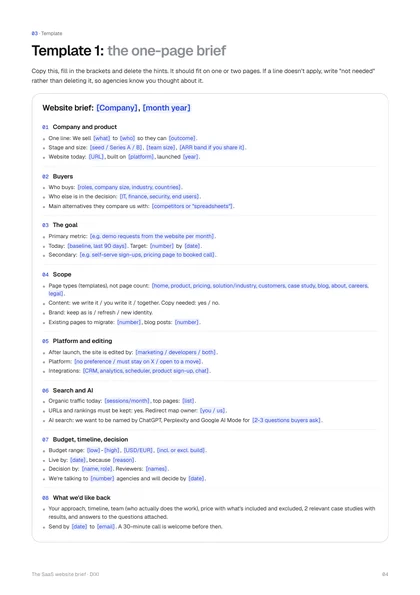
- 3Template 1: the one-page briefEight short sections you can fill in in an hour.
- 4Template 2: the full RFPFor procurement, several stakeholders or a larger budget.
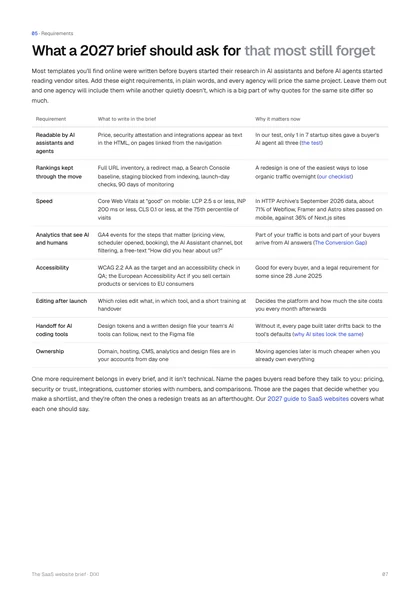
- 5What a 2027 brief must ask forAI agents, rankings, speed, analytics, accessibility, editing, handoff, ownership.
- 6Budget and timelinePublished agency prices for six kinds of project, with sources.
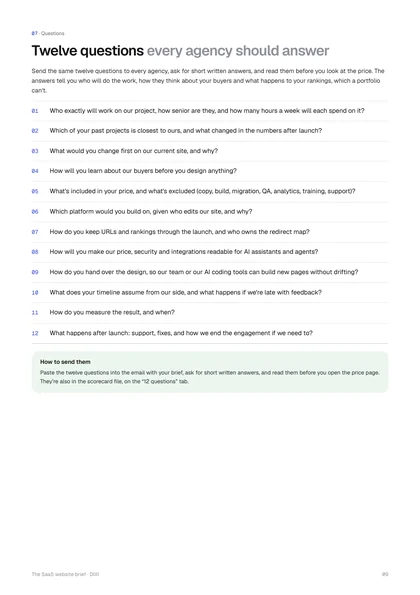
- 7Twelve questions for every agencyThe answers tell you what a portfolio can’t.
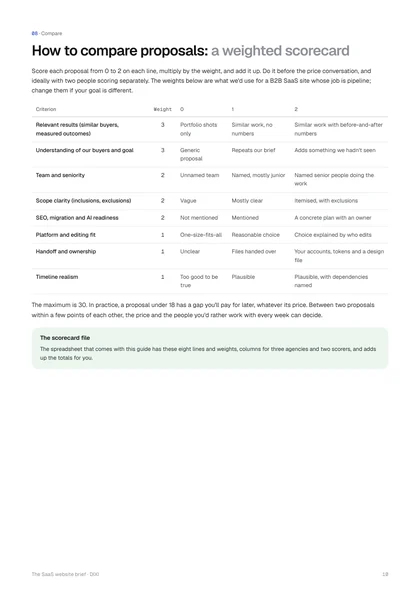
- 8A weighted scorecardScore proposals 0 to 2 on eight lines before you talk price.
- 9Red flags and the three-week processFrom brief to signed contract, day by day.
- 10A filled exampleTemplate 1 for a fictional Series A company.
Six decisions only you can make.
A brief goes wrong when the company hasn’t decided something and hopes the agency will. Settle these in a 45-minute meeting with whoever will sign off.
- 01
The one outcome
What should the new site change, in a number? "Demo requests from the website up from 40 to 60 a month" is a goal. "A modern site that reflects our brand" is a wish. Pick one primary metric and up to two secondary ones, and write down today's baseline.
- 02
The budget range
Agencies propose very different projects for $15,000 and $60,000. Giving a range doesn't mean you'll be charged the top of it; it means you'll get proposals you can compare. If you truly don't know, use the ranges in the budget section below.
- 03
The deadline and why
A fundraise, a launch, a conference or a board meeting. A real reason helps agencies plan backwards; an invented one makes them pad the price.
- 04
Who decides
Name the person who signs off, and the people who review. A common way projects slip is someone senior seeing the work for the first time at the final review and starting over.
- 05
Who will edit the site after launch
Marketing in a visual CMS, developers in code, or both. This decides the platform (Webflow, Framer, Astro with a CMS, or something else) more than any design preference. We compared the options in Webflow vs Framer vs Astro.
- 06
What's in and what's out
Copywriting, brand work, illustrations, product screenshots, video, migration of old content, integrations. Each one can move a quote a long way if one agency includes it and another doesn't.
Write one page that covers the goal and the metric, your buyers, the scope as page types (not page count), who will edit the site, your SEO and migration needs, the budget range, the deadline and who decides. Send it to three agencies, ask every one the same twelve questions, and score the answers before you look at price.
What a SaaS website costs in 2027.
For a B2B SaaS marketing site, published starting prices run from about $5,000 to $50,000, and the 15 of the 20 agencies we checked in November that quote in dollars have a middle starting price of $12,000.
| Project | Published prices | Typical timeline |
|---|---|---|
| Redesign of one key page (homepage or pricing) | from $8,000 (DIXI Conversion Sprint) | 3–4 weeks |
| 5-page SaaS site, designed and built | Starting prices $5,000–$50,000, middle $12,000 (15 agencies that quote in dollars); $12,000–$16,000 with us | 3–12 weeks |
| About 15 pages with a CMS (copy and migration extra) | $15,000–$80,000 (agencies' own estimates for larger builds) | 8–16 weeks |
| A US agency that prices projects | From about $25,000; Ramotion lists $50,000–$150,000+ | 8–24 weeks |
| Moving platforms with the same design | from $6,000 (DIXI migration to Astro) | 3–5 weeks |
| Design and development every month after launch | $595–$6,000 a month, median about $3,500 (12 published plans) | Ongoing |
Sources: our checks of 20 SaaS web design agencies (16–17 Nov 2026) and 13 agencies and studios (3–5 Nov 2026), and DIXI's pricing.
Put a range in the brief
It feels like giving away your negotiating position, but it does the opposite. Without a range, one agency proposes a $15,000 site and another a $90,000 programme, and you can't compare either. With one, every proposal shows what that money buys, and the good agencies tell you what they'd cut or add.
Count your own team's time
Someone on your side writes or approves copy, gathers screenshots and customer quotes, joins weekly reviews and signs off. Plan a few hours a week from marketing and an hour a week from the decision-maker for the length of the project. When that time isn't there, the agency waits and the launch date moves.
Work back from the date
Choosing an agency takes 2 to 3 weeks if you move quickly. Add the project timeline, then two weeks of slack for content and approvals. If your launch is tied to a fundraise or an event, you probably need to send the brief this month.
What most briefs still forget.
Most templates online were written before buyers started their research in AI assistants and before AI agents started reading vendor sites. Add these requirements, in plain words, and every agency will price the same project.
| Requirement | What to write in the brief | Why it matters now |
|---|---|---|
| Readable by AI assistants and agents | Price, security attestation and integrations appear as text in the HTML, on pages linked from the navigation | In our test, only 1 in 7 startup sites gave a buyer's AI agent all three (the test) |
| Rankings kept through the move | Full URL inventory, a redirect map, a Search Console baseline, staging blocked from indexing, launch-day checks, 90 days of monitoring | A redesign is one of the easiest ways to lose organic traffic overnight (our checklist) |
| Speed | Core Web Vitals at "good" on mobile: LCP 2.5 s or less, INP 200 ms or less, CLS 0.1 or less, at the 75th percentile of visits | In HTTP Archive's September 2026 data, about 71% of Webflow, Framer and Astro sites passed on mobile, against 36% of Next.js sites |
| Analytics that see AI and humans | GA4 events for the steps that matter (pricing view, scheduler opened, booking), the AI Assistant channel, bot filtering, a free-text "How did you hear about us?" | Part of your traffic is bots and part of your buyers arrive from AI answers (The Conversion Gap) |
| Accessibility | WCAG 2.2 AA as the target and an accessibility check in QA; the European Accessibility Act if you sell certain products or services to EU consumers | Good for every buyer, and a legal requirement for some since 28 June 2025 |
| Editing after launch | Which roles edit what, in which tool, and a short training at handover | Decides the platform and how much the site costs you every month afterwards |
| Handoff for AI coding tools | Design tokens and a written design file your team's AI tools can follow, next to the Figma file | Without it, every page built later drifts back to the tool's defaults (why AI sites look the same) |
| Ownership | Domain, hosting, CMS, analytics and design files are in your accounts from day one | Moving agencies later is much cheaper when you already own everything |
One more requirement belongs in every brief, and it isn't technical. Name the pages buyers read before they talk to you: pricing, security or trust, integrations, customer stories with numbers, and comparisons. Those are the pages that decide whether you make a shortlist, and they're often the ones a redesign treats as an afterthought. Our 2027 guide to SaaS websites covers what each one should say.
Ask every agency the same twelve.
Ask for short written answers and read them before you look at the price. They tell you who will do the work, how the agency thinks about your buyers and what happens to your rankings.
- 01Who exactly will work on our project, how senior are they, and how many hours a week will each spend on it?
- 02Which of your past projects is closest to ours, and what changed in the numbers after launch?
- 03What would you change first on our current site, and why?
- 04How will you learn about our buyers before you design anything?
- 05What's included in your price, and what's excluded (copy, build, migration, QA, analytics, training, support)?
- 06Which platform would you build on, given who edits our site, and why?
- 07How do you keep URLs and rankings through the launch, and who owns the redirect map?
- 08How will you make our price, security and integrations readable for AI assistants and agents?
- 09How do you hand over the design, so our team or our AI coding tools can build new pages without drifting?
- 10What does your timeline assume from our side, and what happens if we're late with feedback?
- 11How do you measure the result, and when?
- 12What happens after launch: support, fixes, and how we end the engagement if we need to?
Common questions, short answers.
The templates, the scorecard and a filled example are in the download.
What should a website RFP include?
A one-paragraph summary, your company and buyers, the goal with a baseline metric, the scope as page types, content and brand status, platform and integrations, SEO and AI-search requirements, accessibility, timeline, budget range, what to include in a proposal, how you'll choose, and the rules for replying. The RFP template in the download has all of it.
How long should a website brief be?
One to two pages for most companies; five to ten for a formal RFP. Agencies decide whether to reply from the first page, so lead with the goal, budget and deadline.
Should I share my budget in a website RFP?
Yes, as a range. Without one, proposals describe different projects and you can't compare them. A range doesn't commit you to the top of it.
How many agencies should I send a brief to?
Three is usually enough to compare, and five at most. More than that costs you a week of calls and doesn't improve the choice.
How much does a B2B SaaS website cost in 2027?
Published starting prices for a full site run from about $5,000 to $50,000, with a middle of $12,000 among the 15 of 20 agencies we checked that quote in dollars. A site of about 15 pages with a CMS reaches $15,000 to $80,000 before copy and migration, and US agencies that price projects start at about $25,000.
Can I use this brief for a product design project?
Mostly, yes. Swap page types for the flows and user roles in scope, add the platforms (web, iOS, Android), and ask about the handoff to your engineers. For product design prices, see How much does SaaS product design cost in 2027?
One email, no call.
- 01
Leave your email
Takes ten seconds. Any address works, including a personal one.
- 02
Get the guide and files
The PDF, both Word templates and the scorecard open right away.
- 03
Go through it with us, if you want
Fill in the brief and book a 25-minute call. We’ll go through it together.
Questions before you download.
Who is this guide for?
Founders and marketing leads at Seed to Series B B2B SaaS, AI and fintech companies who are redesigning or replacing a marketing site in 2027. Most of it works for product design briefs too.
What do I get?
A 14-page PDF guide, the one-page brief and the full RFP as Word files (they open in Google Docs), and a proposal scorecard in Excel (it opens in Google Sheets) with the weights and the twelve questions.
Is it really free?
Yes. The files open right away, no call and no card.
Do I need a work email?
No. Any email works, including a personal one.
Will you email me?
Only if you ask. To get new guides first, subscribe to The DIXI Letter on the Guides page.
Can you look at my brief?
Yes. Fill it in and book a 25-minute call. We’ll go through it with you: what’s missing, what agencies will read differently, and where the budget and scope don’t match.
