On this page
The short answer
Choose by who will own the website after launch, then by budget. A template or an AI builder is enough while you are still finding the message. A senior freelancer works when someone on your team can run the project and check the work. An agency or studio fits a launch or relaunch that has to land in a few weeks, with strategy, design and build in one place. An in-house designer pays off once marketing changes the site every week, which in our experience starts around Series B for most SaaS companies. The price gap is real: a median-paid web designer costs an employer about $149,000 a year once benefits are added, while agencies that publish prices start at $2,400 to $25,000 for a full site, with a median of $5,000 to $6,500.
| Your situation | Choose | Watch out for |
|---|---|---|
| Pre-seed or early Seed, no designer, the site has to exist this month | A template or an AI builder, set up by the founders | It looks and reads like everyone else's site, and you outgrow it once sales needs proof pages |
| Seed or Series A, a clear brief and one person who can run the project | A senior freelancer, or two (one designs, one builds) | One person's calendar, nobody checking the work, files that live on their accounts |
| A new round, a new story and a site that has to sell it within two months | An agency or studio that designs and builds | Price, a senior team in the pitch and juniors on the work, a site only the agency can change |
| Marketing ships pages and campaigns every week | An in-house designer, or a design partner on a monthly plan | A hire takes about six weeks to fill plus ramp-up, and one person rarely covers strategy, copy and code |
We're DIXI, a founder-led studio that designs and builds SaaS websites, so we sit in the agency column of this comparison. That's why this article says plainly where an agency is the wrong choice, and every market number has a source and a date. Where we had to assume something, the assumption is written down.
How do the five options compare?
A template is the cheapest and the most generic. A freelancer is the most flexible and the most dependent on one person. A design subscription is good for a steady stream of small requests. An agency costs the most per project and carries the most of the work for you. An in-house hire costs the most per year and pays off only when there's enough work to fill it. We opened the sources on 5 November 2026, Webflow's pricing page on 3 November; ManyPixels' subscription index was compiled in October 2026.
| Template or AI builder | Freelancer | Design subscription | Agency or studio | In-house designer | |
|---|---|---|---|---|---|
| What you get | A pre-made design you fill with your content | One person's design or build time | A queue of design requests for a flat monthly fee | A team for strategy, copy support, design, build and launch | A designer on payroll, every working day |
| Typical price | Many Webflow templates cost $49–$149, plus a site plan from about $25 a month; Lovable Pro from $25 a month | Median $15–$30 an hour for web designers on Upwork; senior specialists often $80–$150 | $449 to $15,000 a month; Designjoy lists $4,995 | $2,400–$25,000 to start, by 13 published prices; Clutch reviews average $38,105 | Median wage $104,000, about $149,000 a year with benefits |
| Time to a live site | Days to a few weeks | Depends on scope and on one person's calendar | Ongoing; each request comes back in a few business days | Typically 4–8 weeks by published timelines | About 39 days to fill the role, then onboarding |
| Who runs the project | You | You | You, by queueing requests | The agency, with your sign-off | You |
| What usually goes wrong | Generic message and look; you hit its limits | Availability, no second pair of eyes, unclear ownership | One request at a time; little strategy | Cost, handover, dependence on the agency for changes | One person, one skill set; idle weeks or a backlog |
| Best for | Pre-seed and validation | A defined scope with an owner on your side | A steady flow of pages and assets after launch | A launch or relaunch tied to a round or a new market | Series B and later, with weekly site work |
| Job | Template or AI builderTemplate | FreelancerFreelancer | Design subscriptionSubscription | Agency or studioAgency | In-house hireIn-house |
|---|---|---|---|---|---|
| Message and page plan | |||||
| Copy | |||||
| Design | |||||
| Build and CMS setup | |||||
| QA and launch | |||||
| Changes after launch | |||||
| Cover when someone leaves | |||||
| Left entirely to your team | 6 of 7 | 3 of 7 | 3 of 7 | 0 of 7 | 7 of 7 |
What does each option cost in the first year?
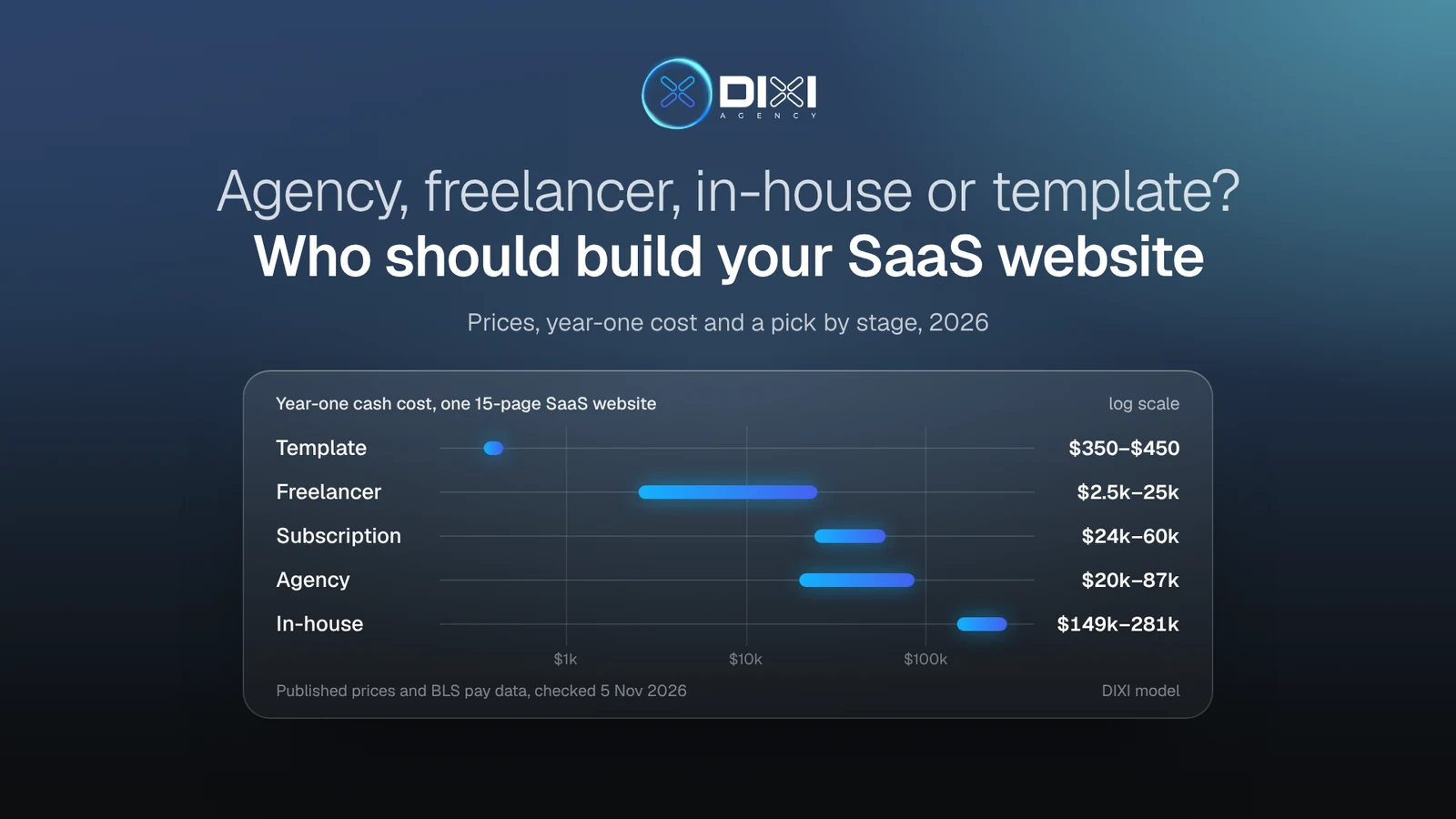
The cash cost of year one runs from a few hundred dollars to well over $100,000. A template costs the least and an in-house hire the most; a year of a design subscription lands inside the range of an agency build plus a year of changes. The cash cost is only part of it, though. The cheaper options cost more of your own team's time, and that time comes from the people who should be selling.
We priced one reference scope: a B2B SaaS marketing site of about 15 pages with a CMS, launched in the first quarter, plus a year of changes. Swap in your own numbers where ours don't fit.
The assumptions behind the chart:
- Template or AI builder: a $49–$149 template, plus a site plan at about $25 a month for 12 months (Webflow's Premium plan billed yearly, or Lovable Pro).
- Freelancer: 120 hours to design and build the site and 4 hours a month of changes, 168 hours in all, at $15 an hour (the low end of Upwork's median for web designers) to $150 an hour (the top of the usual senior freelance rate in the US and Western Europe).
- Design subscription: 12 months of a plan at $2,000–$5,000 a month, where 7 of the 12 published entry plans with web work sit.
- Agency or studio: a $15,000–$80,000 build, from one studio's estimate for a site of about 20 pages to the top of a SaaS studio's published price for a 10–15 page build, plus 4 hours a month of changes at $100–$149 an hour, Clutch's typical agency rate.
- In-house: a full year of one designer at about $149,000 with benefits, or a designer and a developer at about $281,000. Recruiting fees, equipment and the weeks before the hire starts are left out.
The costs that don't show up in a quote:
- Your time. With a template, a freelancer or a subscription, someone on your team writes the brief, gathers content, reviews every page and decides what ships. Budget a few hours a week from a founder or a marketer for the whole project.
- The rebuild. A first site that can't hold the next story gets rebuilt, often right after the next round, and the money spent on the first one doesn't carry over.
- Change requests. Frigade, a Y Combinator startup, left its agency-built Framer site partly because new page templates beyond the ones the agency had built cost "a few hundred to thousands of dollars each", and edits queued up on a co-founder (Frigade). Ask what a new page costs after launch before you sign.
- Hiring overhead. An in-house hire adds recruiting time, a laptop and tools, and the weeks before the new person ships anything on their own.
What do agencies actually charge for a SaaS website?
Agencies and studios that publish prices start at $2,400 to $25,000 for a full marketing site, with a median of $5,000 to $6,500. That comes from 13 that list a starting price for a full multi-page site on their own website, mostly Webflow and Framer specialists, checked on 5 November 2026. With 13 prices the median is the 7th, $5,000; take out any one of the cheaper prices and it becomes $6,500, so read the median as a band.
| Agency or studio | What the price is for | Published price | Timeline | Where it's published |
|---|---|---|---|---|
| Framerfry | Marketing website, 5 to 15 pages | $2,400–$4,700 | 2–4 weeks | Pricing page |
| Flow Hive Digital | Webflow design and development package | From $3,000 | 3–4 weeks | Article, July 2026 |
| Hackceleration | Multi-page Webflow site | €3,000–€15,000 (about $3,380–$16,900) | 4–8 weeks | Service page |
| Studio C | Website design and development | From $3,500 | Not published | Pricing page |
| Digidop | Starter plan | $5,000–$15,000 | Not published | Pricing page |
| Framer Websites | Startup site, 5 pages | $5,000 | 2–3 weeks | Pricing page |
| Waida Studio | Custom Framer website | From $5,000 | Not published | Guide, October 2026 |
| INSAIM | Corporate website in Framer | From $8,000; about $15,000 for 20 pages | 8–12 weeks | Article, October 2026 |
| Goodspeed | Signature site | From $10,000 | 3–6 weeks | Pricing page |
| Foursets | Website redesign | From $15,000 | 4–10 weeks | Pricing page |
| LoudFace | New Webflow build, on top of a retainer from $5,000 a month | $15,000–$60,000 | Not published | Article, September 2026 |
| Flow Ninja | Webflow development | From $25,000 | 8–16 weeks, for its $50,000+ package | Pricing page |
| Grid Rebels | Marketing site refresh, 6 to 8 pages | $25,000–$45,000 | 7–10 weeks | Article, May 2026 |
A starting price is the floor, not the usual bill. A Framer studio that starts at $8,000 says a site of about 20 pages comes closer to $15,000 (INSAIM). A Webflow agency puts its new builds at $15,000 to $60,000, on top of a monthly retainer from $5,000 (LoudFace). A SaaS-focused studio prices a refresh of six to eight pages at $25,000 to $45,000, and a full build of ten to fifteen pages at $45,000 to $80,000 (Grid Rebels). Clutch's reviewed web design projects average $38,105 (Clutch).
What moves the price:
- Pages and page types. Five pages built from one layout cost far less than 20 pages with pricing, security, integration and comparison layouts.
- Copy and strategy. Some prices include positioning and copy. Many assume you send the words.
- Migration. Moving an existing site with redirects and content checks adds work that a new site doesn't need.
- Who does the work. Senior specialists and agencies in the US and Western Europe charge the most per hour; remote teams elsewhere charge less for the same hours.
Timelines. Nine of the 13 publish one: typically 4 to 8 weeks. The cheaper Framer studios quote 2 to 4 weeks. The SaaS specialists that start at $25,000 quote 7 to 10 weeks for a refresh, and one quotes up to 16 for its $50,000+ package.
Monthly plans. Twelve published entry plans that include web design or development run from $595, a discounted price, to $6,000 a month, with a median of about $3,500. Care plans that only keep a site running cost $95 to $1,500 a month.
The sample leans low. Agencies that publish prices tend to be smaller and productised. Many senior SaaS agencies quote only after a call, so expect their quotes to sit above these numbers.
For comparison, DIXI's website projects start at $12k for 6–10 weeks, a focused sprint starts at $8k for 3–4 weeks, and a design partnership starts at $6k a month (pricing).
Why an agency costs more than the person doing the work. Before DIXI I spent more than ten years designing for other people's companies. I was on a top salary, and they billed clients about twice my rate. That gap isn't all profit. It pays for the strategist and the project manager, a second designer who reviews the work, QA before launch, and a replacement when someone leaves mid-project. When you hire a freelancer directly, you take those jobs on yourself. Sometimes that's the right trade.
When is a template or an AI builder enough?
A template or an AI builder is enough while the website's job is to exist, not to sell. Before you have a clear message, a few customers and a sales process, a $100 template on Webflow or Framer, or a site generated in Lovable, gives you a credible page in a week. Spending $20,000 on a site whose message will change in three months is the more expensive mistake.
Signs you've outgrown it:
- Sales sends prospects to the site and has to explain it on the call.
- You need pages the template doesn't have: pricing, security, integrations, comparisons, customer stories.
- Your site looks like the template's demo, and so do two of your competitors'.
- Every change takes a founder's evening.
If you build with an AI tool, keep the same standard as for any code site. Our Webflow vs Framer vs Astro comparison covers what AI builders do well and what they don't do for you, and the AI-built MVP cleanup guide covers the product side.
When should you hire a freelancer?
Hire a freelancer when the scope is clear and someone on your team can run the project. A good senior freelancer often designs as well as an agency's senior designer and costs less, because you are not paying for the team around them. You become that team: the brief, the content, the reviews, the deadlines and the decisions are yours.
A freelancer works best when:
- the brief is written before they start: pages, audience, the one action each page should drive;
- the copy exists, or you hire a copywriter separately;
- design and build are covered, either by one person who does both or by a designer and a developer who have worked together;
- someone senior reviews the work, because a freelancer has nobody else to catch mistakes.
What it costs. Upwork's median rates for web designers run $15 to $30 an hour (Upwork), while senior freelance web designers in the US and Western Europe charge $80 to $150 (Project Cost Estimator). On marketplaces where many freelancers list, starting prices sit low: on 5 November 2026 the median "starts at" figure across 15 listings in Framer's experts directory was $1,000. Framer doesn't say what that figure covers, so treat it as an entry price, not a quote for a 15-page site.
What usually goes wrong: the freelancer takes a bigger client mid-project, the site is built on their own Webflow or Framer account, the design files live in their Figma, and nobody knows how to change the site once they've moved on. Fix all three in the contract: dates with a fallback, accounts in your name from day one, and a handover call before the last invoice.
Our own story is a cautionary one. The previous dixi.agency was built in Framer by a designer we hired, and it brought no results. In October 2026 we rebuilt it from scratch ourselves, around the questions buyers ask, and that's the version you're reading. The lesson we took: whoever builds the site, someone on your side has to own what it says.
Is a design subscription a good fit for a SaaS website?
A design subscription is a good fit after launch, not for the launch itself. You pay a flat monthly fee, queue requests, and each request usually comes back in two to three business days. That suits a steady flow of landing pages, ad creatives, blog graphics and small page updates. It suits a full website redesign less well, because a redesign needs one team thinking about the whole message and structure at once, not a queue of separate tickets.
Prices vary a lot. ManyPixels' Q4 2026 index of 15 services runs from $449 to $15,000 a month, and notes that the cheaper plans often exclude web design or handle one task at a time (ManyPixels). Designjoy, a well-known one-person subscription, lists $4,995 a month for one request at a time; the page also shows $5,995 (Designjoy). Before you subscribe, check three things: whether web design and Webflow or Framer builds are included, how many requests run at once, and who writes the brief for each one.
A design partner on a monthly plan sits between a subscription and an agency: the same senior team works on your site and product every month, with a plan and a metric rather than a ticket queue. Ours is described on the design partner page.
When does an in-house designer make sense?
An in-house designer makes sense when there is a designer's worth of web work every week, and someone to manage it. That usually means a marketing team shipping pages, campaigns and experiments continuously, which in our experience starts around Series B for most SaaS companies. Before that, a full-time hire tends to spend a lot of the year waiting for briefs or doing work outside the website.
The numbers behind the hire:
- Salary. In the US, the median wage for web and digital interface designers was $104,000 in May 2025, and $92,650 for web developers (BLS).
- Benefits. Wages make up 70.0% of US private employers' compensation costs per hour worked; benefits make up the rest (BLS, June 2026). A $104,000 designer costs about $149,000 a year.
- Time to hire. The median non-executive role took 39 days to fill in SHRM's 2026 benchmark (SHRM), before notice periods and onboarding.
- Coverage. One designer rarely covers positioning, copy, design and front-end code. Many teams we talk to end up hiring a designer and keeping a developer or a studio for builds anyway.
A common pattern that works: an agency or studio does the launch and leaves a design system and a CMS your team can run; a later in-house hire then maintains and extends it. When StackOne moved its site from Webflow to Astro and gave its own team AI coding tools, the time to ship a new page fell from 24–72 hours to 1–2 hours (StackOne). An in-house team with a good system is fast. Without the system, it's one busy person.
What should a Seed, Series A or Series B company choose?
Stage is a proxy for three things: how settled your message is, how many people can review the work, and how often the site changes. Use it as a starting point, then adjust for your team.
| Stage | What the site has to do | Usually the best fit | Typical budget for the site |
|---|---|---|---|
| Pre-seed | Exist, explain the product, collect a waitlist or demo requests | Template or AI builder, run by a founder | Hundreds of dollars plus founder time |
| Seed | Sell to the first real customers and support the next raise | A senior freelancer with a clear brief, or a studio for a focused first version | About $3,000–$15,000; 10 of the 13 published agency starting prices fall here |
| Series A | Tell the new story, support a sales team, rank and get cited | An agency or studio for the relaunch, then a monthly partner or a freelancer for changes | About $15,000–$80,000 for the relaunch, depending on pages and scope, plus a monthly plan for changes |
| Series B | Run campaigns, experiments and new markets every week | An in-house designer, with a studio or partner for big projects | A salary of about $149,000 loaded, plus project budgets |
If you're between stages, choose by the hardest job in the next 12 months. A Seed company entering an enterprise market needs Series A-level work on its security, integrations and customer pages.
How do you choose an agency or a freelancer?
Choose by the work they show for companies like yours and by who will do the work, then by price. A strong portfolio from consumer brands says little about a B2B SaaS site that has to explain a product to a buying committee. Use the scorecard below on your calls: ask each question, score the answer 0, 1 or 2, and compare totals. Anything under 12 out of 20 is a risk.
| # | Ask | A strong answer (2 points) | A red flag (0 points) |
|---|---|---|---|
| 1 | Show me two B2B SaaS sites you designed and what changed after launch | Live sites, a number they measured, a name or a reference | Dribbble shots only, no results |
| 2 | Who exactly will design and build our site? | Names, the people on this call | "Our team", someone you haven't met |
| 3 | What do you need from us, and when? | A list: brief, content, access, reviews, with dates | "Nothing, we handle it all" |
| 4 | Who writes the copy? | A clear answer and a price, or a copywriter they work with | Placeholder text until you send yours |
| 5 | How do you protect SEO when we move from our current site? | A redirect map, content parity, Search Console checks after launch | No answer, or "Google will figure it out" |
| 6 | Which platform will you build on, and why? | A recommendation tied to who will edit the site | The one platform they always use |
| 7 | Whose accounts are the site, the domain and the design files on? | Yours, from day one | Theirs, "for convenience" |
| 8 | What does a new page cost after launch? | A price, or "you can build it yourself from the system" | It depends, every time |
| 9 | What does the price include, and what is extra? | A written scope with pages, rounds of changes and launch support | One number with no scope |
| 10 | What happens if the project runs late? | Dates, a weekly update, what moves if it slips | Vague comfort |
Download the scorecard as a one-page PDF to score up to three candidates side by side on your calls.
The brief you send before these calls matters as much as the questions. Next week we publish our SaaS website brief and RFP template, so every quote you get answers the same questions.
What should you own, whoever builds the site?
Own every account and every file from day one, whoever builds it. It costs nothing at the start and saves a rebuild later.
- The domain and DNS, in a company account with two admins
- The website platform account (Webflow, Framer) or the code repository and hosting
- The design files, in your company's Figma
- Analytics, Search Console, the tag manager and the cookie consent tool
- Forms and the CRM connection
- A short handover document: how to add a page, where the components live, who to call
FAQ
Is it cheaper to hire a freelancer or an agency for a SaaS website?
A freelancer usually costs less per hour and per project, because you aren't paying for a project manager, a reviewer or a team. You take those jobs on yourself. Clutch's reviewed web design projects average $38,105 with agencies charging $100–$149 an hour, while median Upwork rates for web designers are $15–$30 an hour.
How much does a B2B SaaS website cost in 2026?
A template-based site costs a few hundred dollars plus your time. In our year-one model, a freelancer-built site costs a few thousand to the low tens of thousands of dollars. Agencies that publish prices start at $2,400 to $25,000 for a full site, their own estimates for a full multi-page build run from about $15,000 to $80,000, and Clutch's reviewed web design projects average $38,105. DIXI's website projects start at $12k for 6–10 weeks, and our cost calculator gives a range for your scope.
Should a startup hire an in-house designer or an agency?
Hire in-house when there's a full-time designer's worth of work every week, which in our experience comes around Series B. Before that, an agency or studio for the launch and a monthly partner or freelancer for changes usually costs less than a $149,000 loaded salary and covers more skills.
Is a website template good enough for a SaaS startup?
At pre-seed and early Seed, yes. Many Webflow templates cost $49–$149, and a template on Webflow or Framer gets a credible site live in days. You outgrow it when sales needs pricing, security, integration and customer pages the template doesn't have, or when your site looks like your competitors'.
Are unlimited design subscriptions worth it?
For a steady flow of small requests after launch, often yes. For a full redesign, usually not, because many plans work on one request at a time and leave the strategy to you. Prices run from $449 to $15,000 a month (ManyPixels, Q4 2026).
How long does it take to build a SaaS website?
A template site can go live in days. Agencies that publish timelines typically quote 4 to 8 weeks for a full site, and DIXI's website projects take 6–10 weeks. Hiring a designer first adds about six weeks to fill the role.
What should I ask a web design agency before hiring?
Ask who will do the work, what they need from you and when, who writes the copy, how they protect SEO in a move, whose accounts the site lives on, and what a new page costs after launch. The ten-question scorecard above turns the answers into a score you can compare.
How much do Webflow and Framer agencies charge in 2026?
Among the 13 agencies and studios we checked on 5 November 2026, most of them Webflow and Framer specialists, published starting prices for a full marketing site run from $2,400 to $25,000, with a median of $5,000 to $6,500, and timelines are typically 4 to 8 weeks. Their own estimates for a larger multi-page build reach $15,000 to $80,000. Each agency, with a link to its price, is in the table in the agency prices section.
Can I switch from a freelancer or template to an agency later?
Yes, and it's common after a funding round. It's easier if the domain, platform account, design files and analytics are already in your name. Plan the move with a redirect map so the new site keeps the search traffic the old one earned.
How we got these numbers
- Agency prices: the 13 agencies and studios are listed with links in the table above and in the CSV (CC BY 4.0). We looked for agencies and studios that publish a starting price for a full multi-page marketing site on their own website and opened each page on 5 November 2026. We kept 13: 7 with a pricing page, 1 with a service page and 5 with a dated article or guide on their own site. Two of the 13 prices are for a redesign or a refresh rather than a new build. Landing-page-only and development-only prices were left out, and so were agencies that quote only after a form or a call, which is why the sample leans toward smaller, productised studios. Euro prices were converted at 1.1267 USD per euro, the ECB reference rate of 4 November 2026. The median is the middle value; with 13 prices, one entry moves it from $5,000 to $6,500, so we report both. Timelines come from the 9 agencies that publish them. Monthly plans come from 12 published entry plans that include web design or development, priced per month; one of them requires a 12-month term. The marketplace figure is the median "starts at" price shown on Framer's experts directory on the same day.
- Freelancer rates: Upwork's published median hourly rates for web designers, and Project Cost Estimator's 2026 rate guide, based on more than 600 project quotes, for senior rates.
- In-house cost: BLS median annual wages for May 2025 (web and digital interface designers; web developers), divided by the 70.0% wage share of employer costs for private industry in June 2026 (BLS Employer Costs for Employee Compensation). Time to fill from SHRM's 2026 recruiting benchmark.
- Subscriptions and templates: ManyPixels' Q4 2026 pricing index of 15 design subscriptions, Designjoy's own page, Netguru's 2025 guide to Webflow template prices, and Webflow's and Lovable's pricing pages.
- DIXI prices: from our pricing page, 5 November 2026.
Sources
All pages opened on 5 November 2026 unless another date is given.
- Pay and hiring: BLS: web developers and digital designers (median pay, May 2025), BLS: Employer Costs for Employee Compensation (June 2026), SHRM recruiting benchmark, 2026
- Freelancers: Upwork: how much a web designer costs, Project Cost Estimator: web design pricing guide 2026, Framer experts directory
- Agencies: Clutch web design pricing guide, INSAIM: Framer website cost, LoudFace: Webflow agency pricing, Grid Rebels: SaaS website design cost in 2026, plus the pricing pages of the 13 agencies and studios in our check
- Subscriptions: ManyPixels design subscription pricing index, Q4 2026, Designjoy
- Templates and AI builders: Netguru: Webflow template costs (April 2025), Webflow pricing (checked 3 November 2026), Lovable pricing
- Teams that changed how they build: Frigade: we left Framer, StackOne: rebuilding our marketing site
- DIXI: pricing