On this page
The short answer
A free trial usually stalls for one of four reasons, and it's rarely the credit card question. The wrong people start it, they never reach a first result, the trial ends before the person who pays has seen it, or the payment step fails. If your trial users are in Europe or the UK, add a fifth: the checkout and the paperwork don't fit how European companies buy, from card authentication and VAT numbers to the data processing agreement their privacy team asks for. For a target, ChartMogul's 2026 survey of 200 products rates 4–6% of no-card trial users paying within six months as good and 10–15% as great. For trials that need a card, 25–35% is good and 50–60% is great. If your numbers dropped suddenly rather than sitting low, start with the six checks below.
| What you see | Most likely cause | Fix first |
|---|---|---|
| Many signups, few come back for a second session | The wrong people start, or the page promised something the product doesn't do on day one | Check sources and work emails, then ask one question at signup |
| Users log in but never set anything up | No first result in the first session | Define the activation event, add sample data, cut the checklist to three steps |
| The user is active, nobody upgrades on day 14 | The buyer hasn't seen it yet | Invites, a summary the user can forward, an extension on request, a person for big accounts |
| Upgrade clicks, but few payments | An unexpected price, a failed card check, no invoice option | Price on the paywall, card authenticated at signup, invoice and direct debit |
| EU and UK trials convert worse than US ones | Card authentication, VAT, the DPA, currency, language | The Europe and UK checklist below |
We're DIXI, a founder-led studio that designs SaaS products and websites, including signup, onboarding and upgrade flows. This guide starts with the market numbers, then goes leak by leak, then covers what changes when your trial users are in Europe or the UK. Every number has a source and a date. The legal and tax parts are a map of what to check with your payment provider, accountant and lawyer, not legal advice.
What is a good free trial conversion rate in 2026?
ChartMogul's 2026 survey of 200 software products is the most cited source. It rates 4–6% of trial users paying within six months as good and 10–15% as great when no card is needed to start. When a card is needed, 25–35% is good and 50–60% is great. B2B products convert a little better than B2C ones, and the median across all free models is 8%.
| Model | Good | Great |
|---|---|---|
| Free trial, no card | 4–6% | 10–15% |
| Free trial, card required | 25–35% | 50–60% |
| Reverse trial (paid features first, then a free plan) | 4–6% | 8–12% |
| Freemium | 3–5% | 8–12% |
Does asking for a card help? The two big datasets disagree
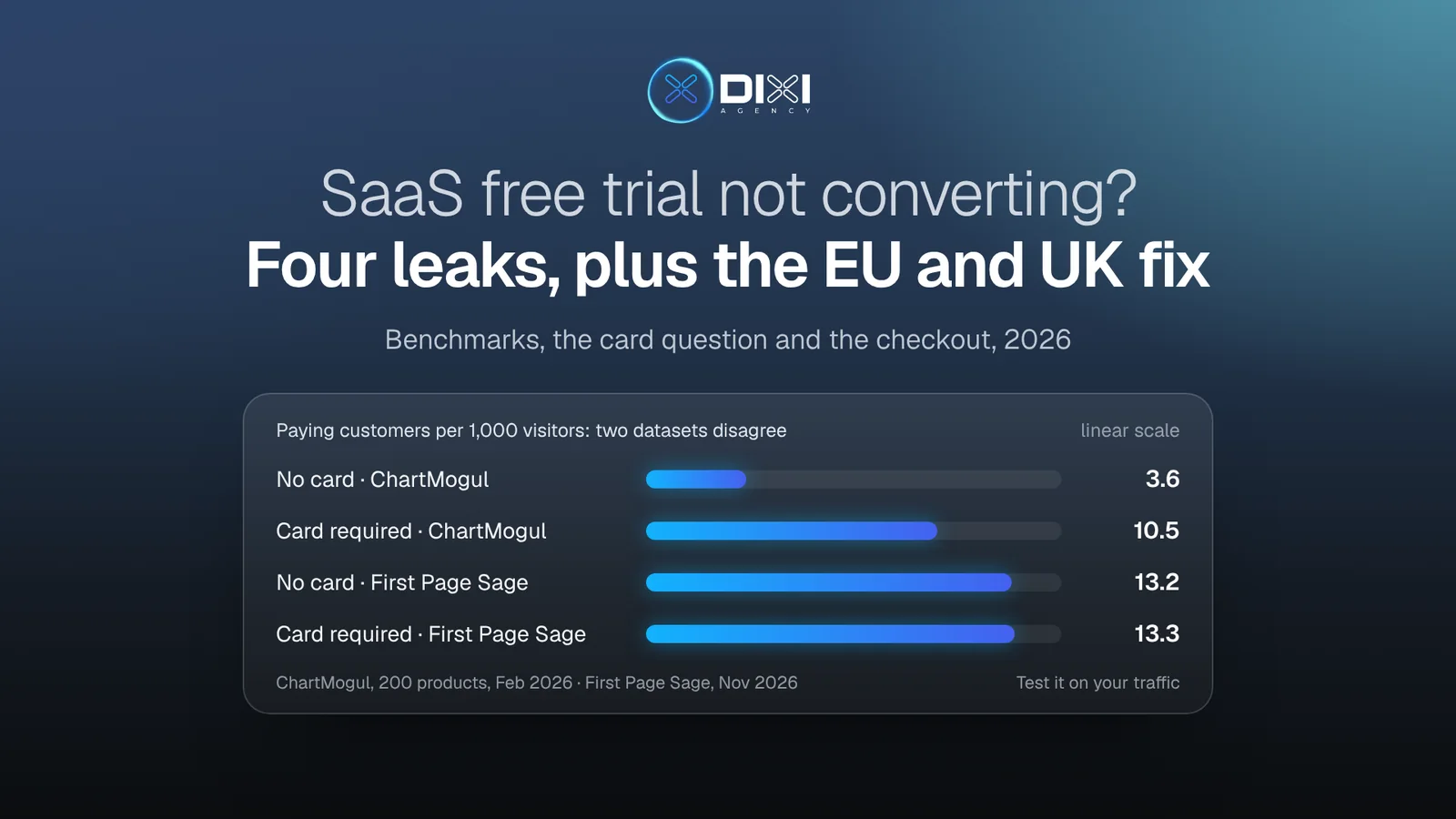
Asking for a card means fewer people start the trial and more of them pay, so the fair comparison is paying customers per 1,000 visitors. Here the two largest public datasets point in different directions:
| Paying customers per 1,000 visitors | No card | Card required |
|---|---|---|
| ChartMogul (survey of 200 products, Jan 2026) | 3.6 | 10.5 |
| First Page Sage (89 SaaS clients, Nov 2026) | 13.2 | 13.3 |
The difference comes from who is measured. ChartMogul surveyed 200 products, 22% of them B2C or hybrid, and counted a customer who paid within six months. First Page Sage reports its own agency clients, who run search marketing with it, and counts a single paid month. In the first dataset a card triples paying customers; in the second it changes almost nothing.
So treat the card as something to test, not a fix. It tends to suit products that show their value in the first session and buyers who have a company card. In the EU and the UK it also means authenticating the card at signup, which we cover below. Test it on one traffic source for a month and compare paying customers per 1,000 visitors, not trial-to-paid alone.
By industry, First Page Sage's trial report (client data from 2022 to 2025) puts trial-to-paid at 29.0% for CRM, 22.7% for HR, 21.9% for cybersecurity, 19.4% for fintech and 18.6% for enterprise software. Products with a longer setup and a bigger buying group sit lower, which is the pattern behind leaks 2 and 3 below. For the website stages before the trial, from visitor to signup, see our B2B SaaS conversion rate benchmarks.
Trial conversion suddenly dropped? Six checks first
A sudden drop usually has a cause outside the product: tracking, payments, a new traffic source or a price change. Check these before you redesign onboarding. Each takes minutes.
- Tracking. Compare trials and payments in your product database or billing tool with what analytics shows. In the EU and the UK, a new or changed cookie banner can cut the share of visitors analytics sees, so conversion looks lower while real signups and payments haven't moved.
- Payments. Look at trial-end invoices that failed or are waiting for card authentication. A new payment provider, a changed 3D Secure setting or a new plan setup shows up here first.
- Traffic mix. A campaign, a viral post or a new referral source can bring many signups that were never going to pay. Split trial-to-paid by source and by signup week.
- Price and plans. Did anything change on the pricing page or the paywall, including the currency or how VAT is shown?
- Product and emails. A broken onboarding step, a slow import, or an onboarding email that stopped arriving. Check the delivery and open rates of your trial emails, not only whether they were sent.
- The calendar. Compare with the same weeks last year. B2B buying is often slower in August in much of Europe and in the last weeks of December.
Step 0: is it the trial, or who starts it?
Before you change onboarding, check who is signing up. ChartMogul's report groups what worked for the teams that improved conversion into five areas, and the first two are about who starts the trial: more targeted acquisition and attracting higher-intent users.
Four checks take an afternoon:
- Work emails. What share of signups use a company domain rather than a free mail service? A low share points to students, competitors and tire-kickers.
- Fit. What share come from your target countries, company sizes and roles?
- Trial-to-paid by source. Organic search, paid ads, AI assistants, partners and outbound usually convert very differently. If one source converts at half the rate of the others, fix the source or the page it lands on, not the product.
- The promise. Read the ad, the landing page and the first screen after signup in one go. If the page promises an outcome the product can't show on day one, users leave disappointed, and onboarding won't fix that.
If the website is the problem, our conversion rate benchmarks have a checker for each stage, and Traffic but no demos? covers the page-level fixes.
Leak 1: people start a trial without a job to do
A signup form that asks only for an email gets you trials with no goal. Those users look around, see an empty account and leave. One question at signup, such as "What do you want to do first?", lets you open the right template, send the right emails and tell sales which accounts matter.
- Ask one or two questions at signup: the first job and the team size. Use every answer, or don't ask it.
- Open the product on the matching template or example project, not a blank page.
- Say on the signup page what happens in the first ten minutes, so people arrive with time set aside.
- Keep the promise the same from the ad to the homepage to the first screen in the product.
Leak 2: they never reach the first result
Most trial users never get to the moment where the product does its job for them. Userpilot's benchmark of 62 B2B SaaS companies puts the average activation rate at 37.5%, and its wider dataset of 547 companies puts the average time to first value at about a day and a half. In a 14-day trial, that's a big part of the window, and many users don't come back for a second day.
Activation also depends on the category. In Userpilot's data, AI and machine learning products activated close to 55% of users, while fintech and insurance products activated 5%, because connecting a bank account or importing financial data takes longer than typing a prompt. If you sell a fintech, data or analytics product, the first session has to show something useful before the integration is finished.
- Name your activation event: the action after which users convert far more often, such as the first report shared, the first integration connected or the first invoice sent. Measure it for each week's signups.
- Add sample data to empty accounts, so users see the result before they set up their own.
- Cut the checklist to three to five steps. Userpilot's benchmark puts the average onboarding completion rate at 19.2%, so a long checklist mostly goes unfinished.
- Make the import or integration step resumable, and send a reminder from a person when it stalls.
- Watch five session recordings of trials that didn't convert. You will usually find the same screen in most of them.
Leak 3: the trial ends before the buyer has seen it
In B2B, the person who tries the product is often not the person who pays for it. A 14-day trial can end with a keen user and a manager who has never logged in. ChartMogul found that 80% of free-trial products add a human touchpoint for enterprise users, most often from customer success or sales-assist, rather than leaving big accounts to self-serve.
- Make inviting a colleague a step in onboarding, with a reason: review, approve, or see a shared report.
- Give the user something to forward: a one-page summary of what their team did in the trial, the price for their seats, and links to security and data protection documents.
- Let users extend the trial once, by themselves, for a week, instead of making the default trial longer.
- Route accounts above a size you choose to a person in the first days, not on day 13.
- While you have only a few dozen trials a month, write to every new trial user from a founder's address and offer a short call. You'll learn more from ten of those calls than from any dashboard.
- Show the end date and what happens next inside the product, not only in email.
Leak 4: the paywall and the payment step
Users who click Upgrade and don't pay are the cheapest leak to fix, because they have already decided. The usual causes are a price they didn't expect, a plan page that doesn't say what they keep and what they lose, or a payment that fails.
Price surprises often start on the website. In TrustRadius's 2026 survey of 1,862 technology buyers, transparent pricing was the change buyers most wanted from vendors for the fourth year running: 59% wished for it, and 42% named it as the one thing they would change.
- On the paywall, show the price in the user's currency, the plan they are on and what changes when the trial ends.
- Keep their work if they don't pay: read-only access or a free tier, not deletion. People come back to data they have built.
- Track failed and incomplete payments at the end of the trial as their own number. Some of the users you count as "didn't convert" tried to pay and couldn't. In Europe this is usually card authentication, covered below.
- Offer annual billing and an invoice for teams, with the option visible before checkout.
What's different in Europe and the UK
Seven things change when your trial users are in the EU or the UK: how card payments are checked, how VAT works for business buyers, how companies prefer to pay, which data protection paperwork they need before they use real data, the currency and language, what you can email them, and, for plans sold to individuals in the UK, new subscription rules. A funnel built for US buyers doesn't show any of these. They simply show up as "trials from Europe convert worse".
This section is a list of what to check, with the official sources we used. Rules were checked on 7 November 2026. Confirm the details for your company with your payment provider, accountant and lawyer.
1. Card payments need authentication, even for a free trial
Under the EU's PSD2 rules, and the UK's own version of them, online card payments need Strong Customer Authentication: the customer's bank checks two of something they know, have or are, usually through 3D Secure. Stripe's support documentation says the first charge that creates a subscription has to be authenticated even when it starts with a free trial. The fix is to collect and authenticate the card at signup (in Stripe, with a SetupIntent), so the charge at the end of the trial can run as a merchant-initiated payment without the customer present. Banks can still ask for authentication at that point, so you also need an email or an in-app message with a link to confirm the payment.
Check this week: in your billing tool, count trial-end invoices for EU and UK cards that ended as "requires action" or "incomplete". These are customers who decided to pay. If there are more than a handful, this is your fastest win.
2. Business buyers need a VAT number field and a proper invoice
When you sell a service to a business in another EU country, the European Commission's Your Europe guide explains that the customer pays VAT in their own country through the reverse charge. The UK has its own reverse charge for services bought from abroad. In practice, the checkout needs:
- a VAT number field, checked against the EU's VIES service;
- prices shown without VAT for business buyers, with a clear note;
- an invoice with both companies' names, addresses and VAT numbers that finance can book.
Without these, the trial user has to pay with a personal card and claim it back, or ask finance to sort it out, and the upgrade waits.
3. Give a way to pay that isn't a company card
If the only way to pay is a company card, the trial depends on whether the user has one. Offer direct debit (SEPA Direct Debit in the euro area, Bacs Direct Debit in the UK) and pay by invoice for annual plans above an amount you set. Stripe and the other common billing tools support both.
4. The privacy team may need your DPA before the team uses real data
If the trial involves personal data, such as customers, employees or contacts, the buying company is the controller and you are its processor. Article 28 of the GDPR requires a contract between them, usually a data processing agreement (DPA). A team can explore with sample data, but the moment they import their own, a careful company will want your DPA, your list of sub-processors and the region where data is hosted. If those sit behind "contact sales", the trial stops at exactly the step where it should get serious.
US vendors will also be asked how transfers to the US are covered. One route is the EU-US Data Privacy Framework, which US companies can certify to; the European Commission's adequacy decision for it has applied since 10 July 2023. Put all of this on a public trust page, and link it from the import step in the product.
5. Show prices in euros and pounds, and test the language
Show prices in EUR and GBP, with the VAT note, rather than only in dollars. Language is worth a test too. CSA Research's 2020 survey of 8,709 consumers in 29 countries found that 76% prefer to buy products with information in their own language, and Germany had the largest share, 57%, who buy only from sites in their language. Business software users are not consumers, and CSA's separate B2B survey keeps its results behind a paywall. But if your product screens and onboarding emails are English-only, test a German or French onboarding flow before you blame the product.
6. Trial emails: product emails are fine, marketing has rules
Emails about the account someone just opened, such as setup help and the trial end date, are service messages. Promotional emails are where the rules differ:
- UK: the consent rule for marketing emails under PECR doesn't apply to corporate subscribers, such as limited companies. Sole traders and some partnerships count as individuals, so they need consent or the soft opt-in, as the ICO explains.
- Germany: the unfair competition law (UWG, section 7) requires prior express consent for advertising by email, and it makes no general exception for business addresses. There is a narrow exception for existing customers.
Keep the trial sequence about the product the user signed up for, and ask for marketing consent separately.
7. UK subscription rules from January 2027 (consumers only)
The UK's Digital Markets, Competition and Consumers Act 2024 brings new subscription contract rules. In August 2026 the government brought their start forward, and they apply to contracts made from 1 January 2027. They cover contracts with consumers, not contracts between businesses. They add reminder notices before a free or discounted trial turns into a paid subscription, and a new 14-day cooling-off period after it does. If you sell self-serve plans to individuals in the UK, such as freelancers or creators, plan the reminder email and an easy way to cancel now.
- Cards authenticated at signup; trial-end payments that need action are tracked and followed up
- A VAT number field with VIES validation, prices without VAT for businesses, invoices finance can book
- Direct debit (SEPA, Bacs) and pay by invoice for annual plans
- DPA, sub-processor list and hosting region on a public trust page, linked from the import step
- Prices shown in EUR and GBP
- An onboarding test in the language of your biggest non-English market
- Marketing consent asked separately from the trial; German contacts emailed only with consent
- For UK plans sold to individuals: trial-end reminders and easy cancellation ready for 1 January 2027
Which fix first?
Start with the leaks where people have already decided to pay, then the first session, then the buying group. Payment and paywall fixes take days. Onboarding fixes take weeks, but they usually move the number most.
| If you see this | Fix this first | Effort | Number to watch |
|---|---|---|---|
| Conversion dropped suddenly | The six checks: tracking, payments, traffic mix, price, product, calendar | Hours | Trials and payments in billing, by week |
| Payments failing or stuck at the end of the trial | Card authenticated at signup, a payment recovery email | Days | Failed trial-end payments |
| Upgrade clicks without payments | Price, plan and payment options on the paywall | Days | Paywall view to paid |
| Activation under a third of signups | A first result in session one: sample data, a shorter checklist | 2–6 weeks | Activation rate per signup week |
| Active users, no upgrade | Invites, a summary to forward, a person for big accounts | 1–3 weeks | Trials with two or more users |
| One source converts far worse | That source or the page it lands on | Days | Trial-to-paid by source |
| EU and UK trials convert worse than US ones | The Europe and UK checklist | 1–4 weeks | Trial-to-paid by country |
What to track so you can see the leak
You can't fix a trial you measure only at the end. Track each step as its own event, with the source, the country and the signup answer attached, and report by signup week rather than by calendar month.
- Trial started, with source, country and the answer to your signup question
- Activation event reached
- A second user invited
- Paywall or plan page viewed in the product
- Checkout started
- Payment needed authentication, and whether it was completed
- Paid, or trial ended without payment
Small gains add up. At an 8% baseline, one extra percentage point means 12.5% more paying customers from the same signups, with no extra marketing spend.
FAQ
What is a good free trial conversion rate for B2B SaaS?
ChartMogul's 2026 survey of 200 products rates 4–6% of trial users paying within six months as good and 10–15% as great for trials without a card, and 25–35% as good and 50–60% as great for trials that need one. First Page Sage's client averages run higher, at 17.2% and 49.3%, partly because it counts a single paid month. Compare yourself with your own previous months first.
Our free trial conversion dropped suddenly. What should we check?
Check six things before changing the product: whether tracking still sees every signup (a new cookie banner in the EU or UK can hide some), failed or unauthenticated payments at trial end, a new traffic source, changes to price or the paywall, broken onboarding steps or emails, and seasonality such as August in Europe.
Should we require a credit card to start a free trial?
Test it rather than assume. In ChartMogul's 2026 data, card-required trials produced about three times more paying customers per 1,000 visitors (10.5 against 3.6). In First Page Sage's client data they produced the same (13.3 against 13.2). In the EU and the UK, a card at signup also has to pass Strong Customer Authentication.
Should we offer a free trial at all?
A trial works when users can reach a useful result on their own within days. If setup needs your team, a guided pilot or a demo with a sandbox often converts better. ChartMogul's 2026 report also rates reverse trials, which start with paid features and then drop to a free plan, at 4–6% good and 8–12% great.
How long should a SaaS free trial be?
Fourteen days is the most common length, used by 62% of the products in ChartMogul's 2026 survey, followed by 7 and 30 days at 14% each. The right length is the time your users need to reach a first result plus the time to show it to the person who pays. A self-serve extension on request usually works better than a longer default trial.
Does Strong Customer Authentication affect free trials?
Yes. Stripe's documentation says the first charge that creates a subscription must be authenticated even when it starts with a free trial. Authenticate the card at signup so the trial-end charge can run without the customer present, and send a link to confirm the payment when the bank still asks for it.
Do we need to charge VAT to EU and UK customers on a SaaS subscription?
For business customers in another EU country, the customer usually accounts for VAT in their own country through the reverse charge, so you need a validated VAT number and a proper invoice. Electronic services to consumers are taxed in the customer's country, and the EU's One Stop Shop lets you declare that VAT in one place, according to the European Commission's Your Europe guide. The UK has its own rules. Check your case with an accountant.
Do the new UK free trial rules apply to B2B SaaS?
No. The subscription rules in the Digital Markets, Competition and Consumers Act cover consumer contracts. They apply from 1 January 2027 and require reminders before a free trial turns paid. They matter if you also sell self-serve plans to individuals in the UK.
How we put this together
- Benchmarks: ChartMogul's SaaS Conversion Report in two parts (survey of 200 software products in January 2026, published 4 February and 18 March 2026; conversion means paying within six months). First Page Sage's Conversion Rate Benchmarks for 2026 (published 2 November 2026; trial data from 89 SaaS client companies, a conversion counts one paid month) and its earlier trial report for the industry figures (client data from Q1 2022 to Q3 2025). The two disagree on the card, and we show both. Userpilot's product metrics benchmark for activation, time to value and onboarding completion; each company defines its own activation event, so treat these as context.
- Buyers: TrustRadius 2026 B2B Buying Disconnect Report (1,862 buyers and 444 vendors, surveyed in January 2026).
- Europe and UK rules: Stripe's support pages on SCA and trials, the European Commission's Your Europe VAT guide (updated 13 July 2026), GOV.UK on the UK reverse charge, the GDPR text on EUR-Lex, the Commission's page on EU-US data transfers, the ICO's PECR guidance, the German UWG on gesetze-im-internet.de, and the UK government's announcement of the subscription rules (9 August 2026) with Walker Morris's summary of the guidance. All opened on 7 November 2026.
- Language: CSA Research's 2020 consumer survey. The B2B edition's results are paywalled, so we use only its description.
Sources
All pages opened on 7 November 2026.
- Benchmarks: First Page Sage: Conversion Rate Benchmarks for 2026, First Page Sage: SaaS Free Trial Conversion Rate Benchmarks, ChartMogul: The SaaS Conversion Report (February 2026), ChartMogul: what's working to improve free-to-paid conversion (March 2026)
- Activation: Userpilot: SaaS product metrics benchmark, Userpilot: user activation benchmarks
- Buyers: TrustRadius: 2026 B2B Buying Disconnect findings
- Card payments: Stripe: 3D Secure when a subscription starts with a trial, Stripe: guide to Strong Customer Authentication
- VAT: Your Europe: cross-border VAT, VIES VAT number check, GOV.UK: VAT on services from abroad
- Data protection: GDPR on EUR-Lex (Article 28), European Commission: EU-US data transfers
- Email rules: ICO: PECR electronic mail marketing rules, UWG section 7
- UK subscriptions: GOV.UK: subscription rules brought forward (9 August 2026), Walker Morris: what the new government guidance means
- Language: CSA Research: consumers prefer their own language (2020), CSA Research: Can't Read, Won't Buy, B2B