On this page
The short answer
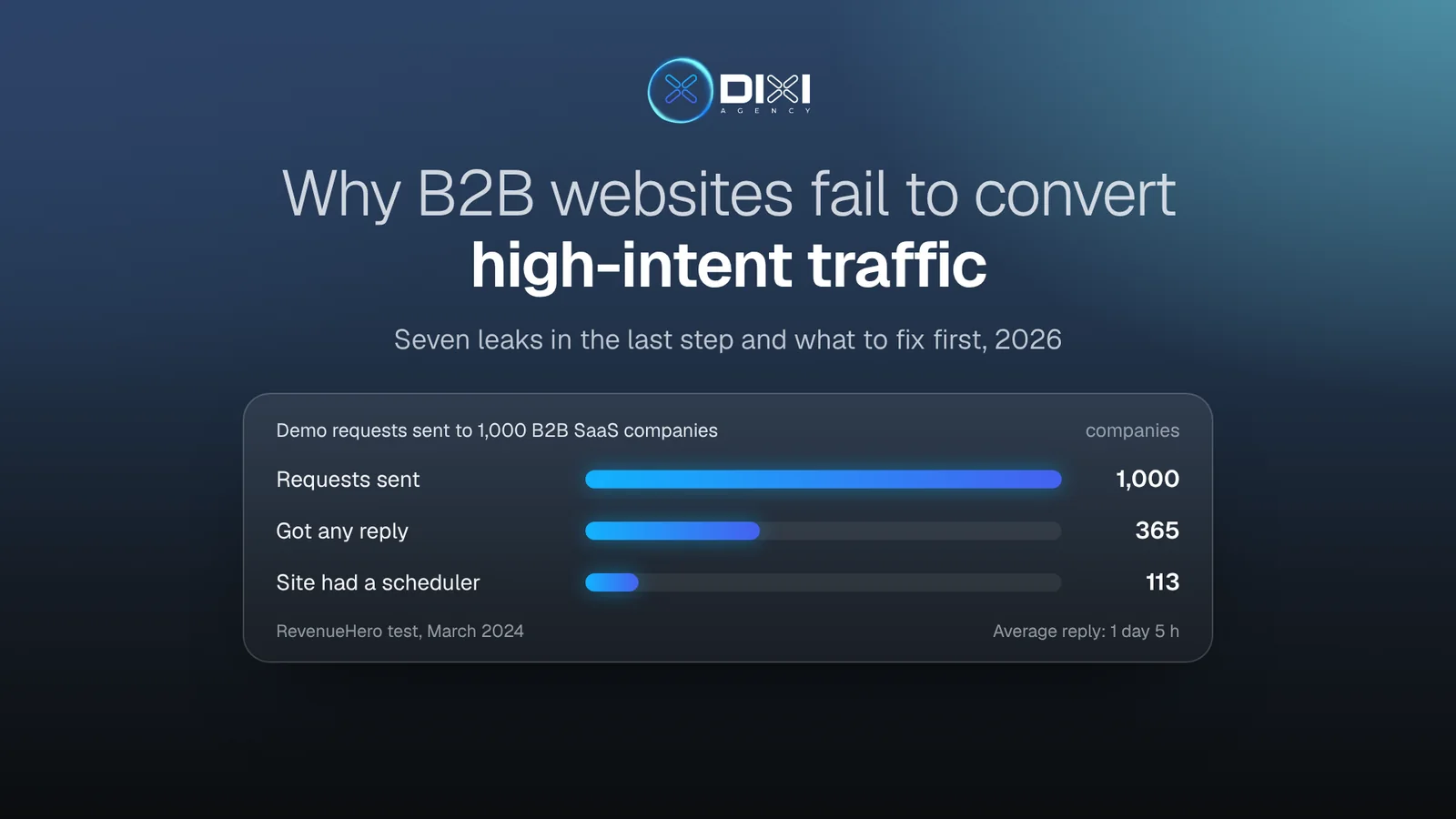
High-intent traffic is the people who open your pricing, demo, booking or contact page. They rarely leave because of your headline. They leave at the last step: the price isn't there, the form asks for something they can't answer, the calendar has no time that suits them, the reply comes a day later or never, or the only way forward is a sales call they don't want yet. The data is blunt. When RevenueHero sent demo requests to 1,000 B2B SaaS companies in 2024, 635 never replied. In Workato's 2026 test of 114 B2B companies, fewer than 1% replied within five minutes. Fix the last step before you redesign the homepage.
| Last step | What goes wrong | Fix first |
|---|---|---|
| Pricing page | No price, or "contact us" for every plan | A starting price or a range, what changes it, a calculator |
| Booking or demo form | Required fields that need a colleague or a guess, errors only after Submit | Require only what routes the lead, show errors next to the field |
| Scheduler | Times days away, an unclear time zone, or no scheduler at all | The next three open times as buttons, in the visitor's time zone |
| Reply | Hours or days later, or never | An instant reply with a booking link and a named person |
| Other ways to talk | A sales call is the only option | Email or a messenger, a price calculator, a recorded demo, a free audit |
| Phones | A banner covers the button, taps feel slow | Test the whole path on a real phone |
| Tracking | Only finished bookings are counted | Track every step, including blocked attempts |
We're DIXI, a founder-led studio that designs and builds B2B websites, and we rebuilt our own booking page along the lines of this checklist. Studies published by companies that sell the fix are marked as vendor data.
Who counts as a high-intent visitor?
A high-intent visitor is someone whose actions say they are close to a decision: they opened pricing, a demo or booking page, or the contact page; they read a case study and then went to pricing; they came back within a week; or they arrived from a comparison or an AI assistant's recommendation. They are usually a small share of your traffic, and they are the share that pays for the website.
Build them as a segment in your analytics and look at it on its own. On most B2B sites they are a small minority of visitors, so your overall conversion rate hides what happens to them: the rest were never going to book.
This article is about the last step only. For the whole funnel, our conversion rate benchmarks give numbers by stage and a checker. For the reasons visitors never reach the last step, such as a vague hero, proof that comes too late or one page for every buyer, see Traffic but no demos?
Leak 1: the price is hidden
A buyer on your pricing page wants to know whether they can afford you before they spend 30 minutes on a call. If every plan says "contact us", many of them leave and assume the worst.
TrustRadius has asked technology buyers what they wish vendors would change since 2023, and transparent pricing has come first every year. In its 2026 survey of 1,862 buyers, 59% wished for it and 42% named it as the one change they'd make. As one quote in the report puts it: "When pricing is hidden, I assume it's expensive."
- Publish a starting price, or a range per plan, even for enterprise deals.
- Say what moves the price: seats, usage, modules, onboarding, contract length.
- For complex pricing, add a calculator. We built one for our own projects: the DIXI cost calculator gives a range and a timeline in about a minute.
- Put the next step on the pricing page itself, such as open times to book, not a link to another form.
Leak 2: the form asks what they can't or won't answer
The number of fields matters less than which ones are required and how errors behave. What breaks a form at the last step is a required question the visitor can't answer alone, an error that appears only after Submit, and a reset that wipes what they typed. In RevenueHero's 2024 test, the average demo form had seven fields.
- Require only what you need to route the request and prepare for the call: name, work email, company and one qualifying question.
- Make everything else optional, and write "optional" in the label rather than relying on a legend of asterisks.
- Show errors next to the field as soon as it's filled in, and never clear the form on an error.
- Decide what happens with personal email addresses. Founders of small companies often use them, so reject them only if you mean to.
- Don't make "how did you hear about us" required. Ask on the call.
The worst case is a visitor who has already chosen a time and then meets questions written for your CRM. For the data on field counts and form types, see reason 9 in Traffic but no demos?
Leak 3: the booking step is a dead end
A visitor who fills in a form and then reads "we'll be in touch" has to wait for you while their interest fades. When the next step is a calendar, it has to show a time that works, soon, in their time zone.
In RevenueHero's 2024 test, only 113 of the 1,000 sites had any kind of scheduler, and 94.48% of the companies that never replied had none. Its 2025 benchmark, built from customers who let visitors book straight from the form, puts the median at 62% of qualified leads booked, against an older benchmark of about 35% when leads waited in a manual review queue (vendor data).
- Show the scheduler right after the form, on the same page.
- Show the next three open times as buttons before the full calendar.
- Show times in the visitor's time zone, and name the zone.
- Offer a way out when no time fits: email, a messenger, or "suggest a time".
- Confirm at once by email with a calendar invite and the name and photo of the person they will meet.
Leak 4: the reply comes late, or never
If there is no scheduler, your reply is the next step, and most companies are slow. In RevenueHero's 2024 test, 635 of 1,000 B2B SaaS companies never replied to a demo request, and the 365 that did took 1 day, 5 hours and 17 minutes on average. In Workato's 2026 test of 114 companies, fewer than 1% replied within five minutes and none phoned within five minutes.
Speed matters because the buyer is comparing you with someone else. In Optifai's CRM data from 939 B2B companies, from Q2 2025 to Q1 2026, leads contacted within five minutes closed at 32%, against 12% for leads contacted after more than a day (vendor data). Workato found that companies using lead routing tools replied in about three and a half hours on average, and those without took nearly 13.
- Send an instant reply with a booking link and a named person, not "we received your request".
- Set a reply target for working hours, such as five minutes, and a separate one for evenings and weekends.
- Route requests to a person by rule, not by whoever checks the inbox first.
- Once a month, fill in your own form from a personal email address and time the reply.
Leak 5: a sales call is the only way forward
Many buyers want to get as far as they can without a salesperson. Gartner's survey of 646 B2B buyers, run in August and September 2025 and released in March 2026, found that 67% prefer a buying experience without a sales rep. If the only next step on your site is "Book a demo", buyers who aren't ready for a call have nowhere to go.
Give high-intent visitors a second path that still moves them closer to buying:
- a price calculator or a plan builder;
- a recorded product tour or a two-minute demo video on the demo page;
- a free trial, a sandbox, or a free audit they can request without a call;
- a direct line, such as email, chat, LinkedIn or a messenger, answered by a person.
Count those direct paths as leads. On our own site, some visitors go from the Contact page to LinkedIn or a messenger instead of the booking form, so we track those clicks as conversions. If your analytics doesn't count them, your conversion rate looks lower than it is, and you can't see which pages start conversations.
Leak 6: the last step breaks on phones
Buyers often find you on a phone and book later on a laptop, or try to book on the phone and give up. Test the whole path, from the pricing page to a booked meeting, on a real phone.
- Is any button covered by a cookie bar, a chat bubble or a sticky banner? Check a small screen, 360 pixels wide, as well as your own phone.
- Do taps respond quickly? Google treats an Interaction to Next Paint of 200 milliseconds or less as good and over 500 milliseconds as poor. Check the field data for your booking and pricing pages, not only the homepage.
- Does the calendar fit the screen without scrolling sideways?
- Does the keyboard cover the field the visitor is typing in?
- Does the form keep what they typed if they switch to another app to check their calendar?
Leak 7: you can't see where they stop
Most sites count only the finished booking or form. If the form blocks people, the number you see is zero and you can't tell why. Track each step of the last mile as its own event.
- Viewed the pricing, booking or contact page
- Started the form (first field touched)
- Picked a date, then a time
- Pressed Confirm, with the error message if it was blocked
- Booking confirmed
- Clicked email, phone, LinkedIn or a messenger
With these in place, "zero bookings" becomes something like "eight people picked a time and the budget field stopped them", which is a fix you can ship the same day.
When high-intent visitors leave anyway
Most high-intent visitors still leave without a form, even on a good site. You can't follow up with someone you can't see, so give them a reason to leave a trace, and find out which companies were looking.
- Offer a smaller step. "Email me the pricing", a downloadable one-pager or a calculator result sent by email asks for less than a call.
- Know which companies visit. Company identification tools match visits to companies by network address. Treat the results with care: many visits resolve to internet providers or cloud servers rather than real companies, and in the EU and the UK you need a lawful basis and the right cookie consent for this kind of tracking.
- Stay in front of them. Retargeting and a short newsletter keep you in view while the buying group decides. Gartner's 2026 research found that 69% of B2B buyers still turn to sales reps to check what AI tools told them, so the call often comes later, after more research.
- Check where they go next. If many leave from pricing to a comparison site or a competitor, the problem is the answer on your page, not the button.
Which fix first?
Start with what you can see and what costs an hour. Tracking first, then the form, then the reply, then the price and the second path.
| Fix | Time to ship | Why it comes here |
|---|---|---|
| Track every step, including blocked attempts | An hour or two | You can't fix what you can't see |
| Make fields optional unless they route the lead | An hour | It unblocks people who have already decided |
| An instant reply with a booking link | Same day | It closes the gap where most companies lose the lead |
| Soonest times as buttons, time zone shown | A day | Most visitors leave before they pick a date |
| A starting price or a range | A day to a week | It answers the first question high-intent buyers have |
| A second path: calculator, tour, direct line | A week | It keeps buyers who aren't ready for a call |
| A test and fixes on a real phone | A day | Many visits start on a phone |
Score your last step in 10 minutes
- Your pricing page shows a price or a range.
- A visitor can reach open times to book within two clicks of the pricing page.
- The booking form requires four fields or fewer.
- Optional fields say "optional".
- Errors show next to the field before Submit, and nothing gets wiped.
- The next open times are visible without clicking through a calendar, in the visitor's time zone.
- A demo request gets a reply with a booking link within five minutes in working hours. Test it.
- There's a way to talk without booking: email, chat or a messenger.
- On a phone, nothing covers the main button, and the form and calendar fit the screen.
- Your analytics shows each step, including blocked attempts and clicks to email or messengers.
Under seven points: fix the last step before you touch the homepage.
FAQ
What is high-intent traffic on a B2B website?
Visitors whose behaviour shows they are close to a decision: they opened pricing, a demo or booking page, or contact, read a case study and then pricing, came back within a week, or arrived from a comparison or an AI assistant's recommendation. They are usually a small share of all visits.
Why do B2B websites fail to convert high-intent traffic?
Usually because of the last step, not the message: a hidden price, required fields they can't answer, no convenient time in the calendar, a slow or missing reply, or no option other than a sales call. Track each step to see which one it is on your site.
Why is our B2B website not converting enterprise prospects?
Enterprise buyers need different answers before they talk: security and compliance (SOC 2 or ISO 27001, SSO, data location), how procurement works, proof from companies of their size, and a realistic starting price or range. If those sit behind "contact sales", the champion can't build the internal case, so they wait or move on.
What are the most common reasons technical buyers leave without converting?
They can't find the documentation, API reference, integrations or a sandbox without booking a call, the pricing doesn't say what usage costs, or the only next step is a sales demo. Give them a self-serve way to check the product, and a direct line to an engineer or founder.
Why do people book a demo and then not show up?
Most often because the meeting is too far away. Published benchmarks agree that no-shows rise as the gap between booking and meeting grows, though none has shared a controlled dataset. Offer times in the next day or two, confirm at once with a calendar invite, send a reminder, and say what the call will cover.
What can we do about high-intent visitors who leave without filling in a form?
Offer a smaller step than a call, such as emailing the pricing or a calculator result, use company identification with care (many matches are internet providers, and EU and UK rules apply), and stay in view with retargeting or a newsletter while the buying group decides.
How do I test my own demo request follow-up?
Once a month, fill in your demo or contact form from a personal email address, at different times of day, and note how long the first real reply takes and whether it offers a time to meet. Do the same on a phone.
How do I track where visitors drop off before booking?
Send an event for each step: page viewed, form started, date picked, time picked, Confirm pressed (with any error), booking confirmed, and clicks to email or messengers. Count Confirm presses before your form checks run, or blocked attempts stay invisible.
How we put this together
- Reply speed: RevenueHero's test of 1,000 B2B SaaS companies (published 20 March 2024) and Workato's test of 114 B2B companies (published 19 March 2026), both made by filling in real demo forms. Optifai's figures come from CRM data of 939 B2B companies (Q2 2025 to Q1 2026).
- Booking rates: RevenueHero's 2025 inbound benchmark, built from its own customers' data, so it shows what's possible with instant booking rather than an industry average.
- Buyers: Gartner's survey of 646 B2B buyers (August–September 2025, press release 9 March 2026), Gartner's 20 May 2026 release on buyers checking AI answers with sales reps, and the TrustRadius 2026 B2B Buying Disconnect Report (1,862 buyers and 444 vendors, January 2026).
- Phones: Google's Interaction to Next Paint thresholds on web.dev.
- Vendor data: RevenueHero, Workato and Optifai sell lead routing, scheduling or sales tools. Their numbers are useful, but they come from companies that sell the fix.
Sources
All pages opened on 7 November 2026.
- Reply speed: RevenueHero: we tested lead response times of 1,000 B2B sales teams (March 2024), Workato: B2B lead response times at 114 companies (March 2026), Optifai: lead response time benchmark
- Booking and forms: RevenueHero: 2025 inbound benchmark
- Buyers: Gartner: 67% of B2B buyers prefer a rep-free experience (March 2026), Gartner: 69% of B2B buyers turn to sales reps to validate AI-generated insights (May 2026), TrustRadius: 2026 B2B Buying Disconnect findings
- Phones: web.dev: Interaction to Next Paint
- DIXI: cost calculator, conversion rate benchmarks, Traffic but no demos?